


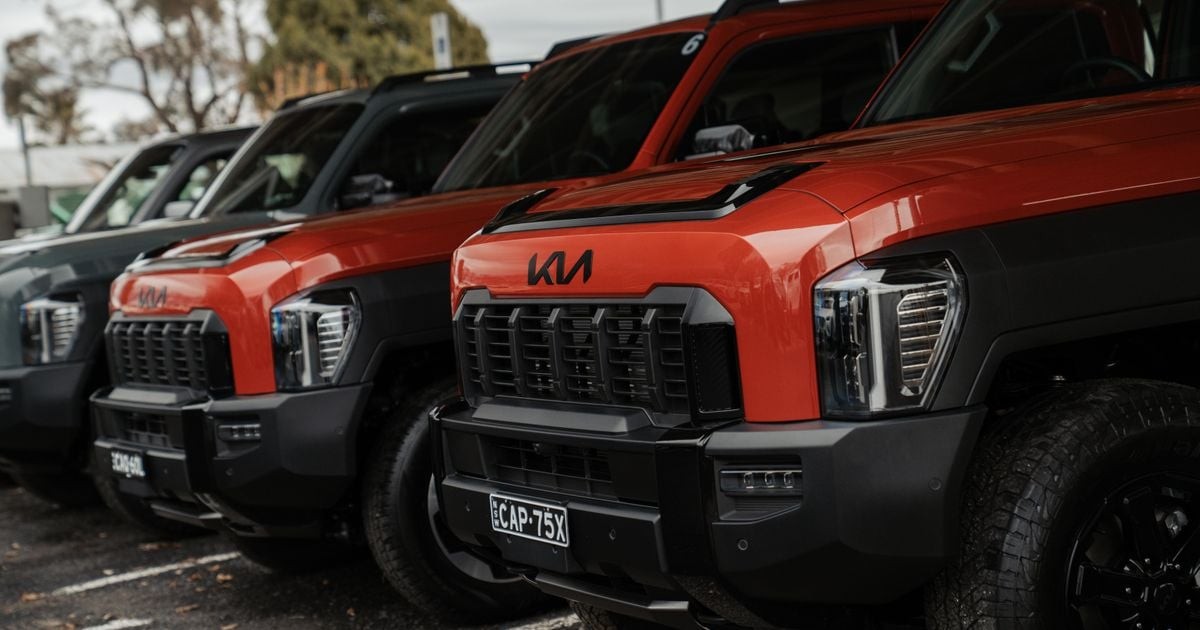
Kia’s Australian leadership is reaffirming its commitment to the Tasman ute, acknowledging its sluggish start while insisting the vehicle will ultimately succeed in the competitive Australian market. Despite falling short of initial sales projections, the company is doubling down, with executives promising increased focus on fleet sales and potential range adjustments to boost performance.
Initial Sales Fall Short of Expectations
Launched in July 2025, the Tasman ute has registered 4,196 units as of late 2025 – significantly below Kia’s initial target of exceeding 10,000 sales in its first year. This lags far behind market leaders like the Ford Ranger and Toyota HiLux, which both surpassed 50,000 units sold in 2024 alone.
The slow uptake is particularly noticeable in entry-level variants, where Kia executives admit they are not capturing their desired market share. “We see a gap in the [entry-level] S range, we’re not getting our fair share there,” COO Dennis Piccoli stated. The company attributes this to insufficient fleet penetration, a segment critical for dual-cab ute success in Australia.
Fleet Focus and Future Adjustments
Kia plans to address this by aggressively targeting fleet buyers, with single-cab/chassis versions slated for release in early 2026. This is a strategic move, as fleet sales often make up a substantial portion of dual-cab ute volume.
However, the company is also prepared to streamline the Tasman range if necessary. Product GM Roland Rivero indicated that Kia may rationalize existing variants to simplify dealer stock management and improve sales focus. “For a Kia product, [the Tasman] is by far away the most complex Kia product… there are a lot of variants there that need to be managed.”
A Competitive Market
The Tasman’s struggles highlight the intense competition in the Australian ute market. The segment has become increasingly fragmented, with numerous brands vying for share and customers demanding diverse powertrain options – from traditional diesel to hybrid models.
“The reality is, that [dual-cab ute] segment has become far more fragmented,” Piccoli noted. “The brands that are in there that are so heavily reliant on their [ute] product, and just the general level of aggressiveness in market… it’s extremely competitive.”
Long-Term Outlook
While Kia remains publicly committed to its long-term sales goals (including a previously touted 20,000-unit annual target), executives are tempering expectations. When pressed on whether the company would hit that target, Piccoli offered a noncommittal “we’ll see.”
The Tasman’s success is crucial for Kia Australia, as the company aims to diversify its sales mix beyond passenger vehicles like the Carnival. However, achieving this will require sustained effort, strategic adjustments, and potentially a willingness to adapt to the realities of a fiercely competitive market.


