


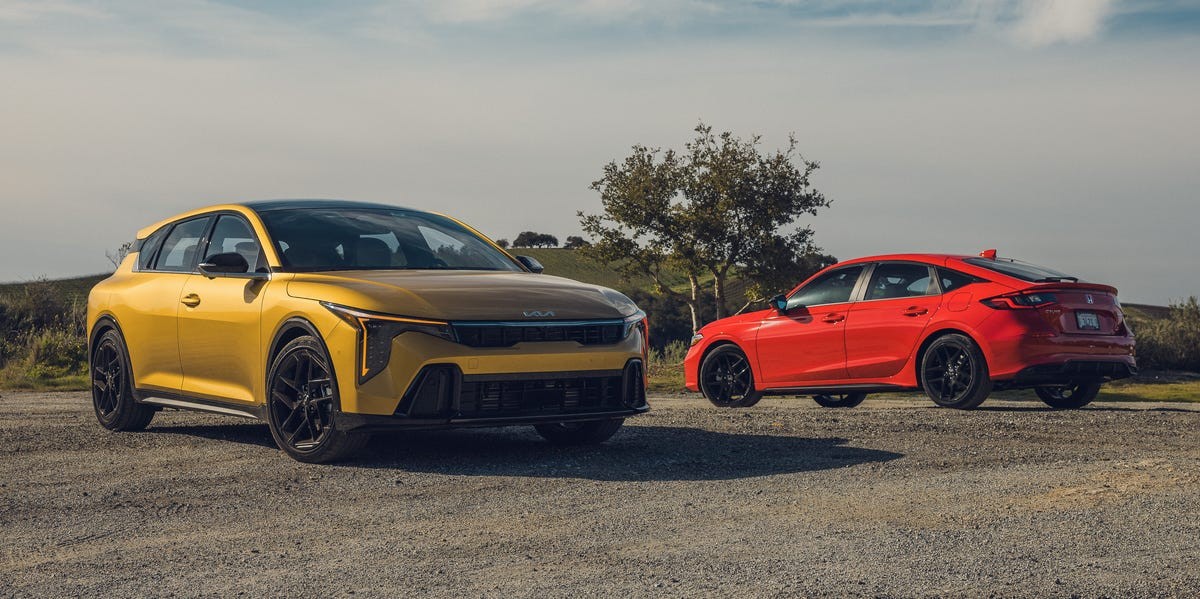
The 2026 compact hatchback market pits the all-new Kia K4 GT-Line Turbo against the established Honda Civic, specifically the Sport Hybrid model. Both cars offer similar horsepower figures—190 for the Kia’s turbo-four and 200 for the Civic’s hybrid system—but their approaches to delivering that power are vastly different. This comparison dives into which vehicle provides a more capable and enjoyable driving experience, considering performance, practicality, and overall value.
Kia K4 GT-Line Turbo: Style Over Substance?
Kia has aggressively reshaped the K4 sedan into a hatchback, retaining the original 107.1-inch wheelbase while lopping off 11 inches of rear overhang. The result is a visually striking vehicle, though some design elements, like the prominent taillights, still feel slightly awkward. The hatch offers a noticeable increase in cargo space—22 cubic feet versus the sedan’s 15—and marginally improved rear headroom (up 1.1 inches).
Inside, the K4 boasts a large central touchscreen and a modern aesthetic. However, ergonomics suffer: climate controls are hidden behind the steering wheel, and the infotainment system prioritizes visual flair over intuitive function. The GT-Line Turbo package ($2300) adds desirable features like ventilated seats, a heated steering wheel, and advanced driver aids, but even with these upgrades, the K4 feels less refined than its rival.
Under the hood, the turbocharged 1.6-liter engine produces 190 horsepower and 195 lb-ft of torque. The eight-speed automatic transmission, however, doesn’t translate that power into thrilling acceleration. The K4 reaches 60 mph in 7.0 seconds—nearly a full second slower than the Civic—and completes the quarter-mile in 15.5 seconds (half a second behind). Handling is also underwhelming, with vague steering and poorly tuned damping that results in a bumpy ride.
Key Takeaways: The K4’s strengths lie in its bold styling and feature-rich options packages. But its compromised ergonomics, middling performance, and lackluster handling make it hard to recommend.
Honda Civic Sport Hybrid: The Balanced Contender
Honda’s approach to the hatchback is more subtle. The Civic retains a five-door look with a shorter rear section (trimmed by 5.8 inches), while maintaining its 107.7-inch wheelbase. Inside, the Civic prioritizes functionality over form. The dashboard layout is clean and intuitive, with well-placed physical controls for climate and audio. While the base 7.0-inch infotainment screen is small, an optional 9.0-inch upgrade is available.
The Civic Sport Hybrid utilizes a unique series-hybrid powertrain, where a 2.0-liter engine primarily acts as a generator for an electric motor that drives the car. This system delivers 181 horsepower and 232 lb-ft of torque, resulting in impressive performance: 0-60 mph in 6.1 seconds and a quarter-mile time of 15.0 seconds. More importantly, the Civic’s handling is precise and balanced, with well-tuned damping and responsive steering.
Key Takeaways: The Civic’s hybrid powertrain, combined with its refined chassis and user-friendly interior, make it the more compelling choice. It’s also more fuel-efficient, achieving 48 mpg combined versus the K4’s 28 mpg.
The Verdict
The Honda Civic Sport Hybrid Hatchback emerges as the clear winner in this comparison. While the Kia K4 GT-Line Turbo offers striking looks and a well-equipped interior, its performance and handling fall short. The Civic delivers a more refined, engaging, and efficient driving experience, making it the smarter purchase for buyers seeking a well-rounded compact hatchback.


