BYD is pushing the boundaries of electric vehicle (EV) charging technology with internal tests of a 1,500 kW flash charging network in Shenzhen, China. The system, which significantly exceeds current industry standards, including Tesla’s V4 Superchargers, represents a major leap forward in charging speed and efficiency. This development underscores the intensifying competition in the EV sector, where rapid charging infrastructure is becoming a key differentiator.
Next-Generation Infrastructure
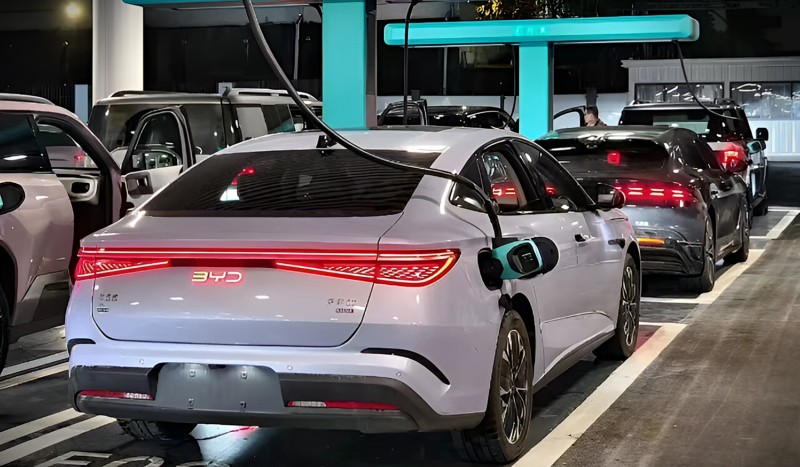
The testing site resembles a traditional gas station forecourt, featuring liquid-cooled charging guns and overhead gantry structures. Leaked images reveal peak output ratings of 1,500 kW with a current capacity of 1,500 A operating on a 1,000 V electrical architecture. This hardware would nearly triple the peak power offered by Tesla’s V4 Superchargers, which currently top out at 500 kW for passenger vehicles.
Access to the testing stations is currently limited to BYD vehicles equipped with a “Flash Charge” badge, including models such as the Tang 9, Song Ultra, Seal 07, Denza Z9 GT, and FCB Tai-series. The system automatically cuts off charging at 97% state of charge, but only for vehicles capable of handling the extreme input power.
Seamless User Experience
BYD’s Flash Charging app is already live on Android, allowing users to locate nearby stations and initiate charging automatically via plug-and-charge functionality. The process reportedly starts within 10 seconds of connection without QR code scanning, streamlining the user experience. Integration with Sesame Credit for potential payment or loyalty programs has also been observed in leaked screenshots.
Pricing at the demonstration site is set at 1.3 yuan per kWh (approximately $0.18 USD), split between electricity costs and service fees. BYD is reportedly offering 1,000 kWh of free electricity annually to compatible vehicle buyers, though formal policy details remain unreleased.
Broader Implications
BYD aims to deploy over 4,000 self-operated flash charging stations across China, with partnerships potentially expanding the network to over 15,000 locations through collaborations with companies like XiaoJu Charging. The deployment of such a high-power network would alleviate concerns about long charging times—a major barrier to EV adoption.
Currently, most public DC fast chargers in China operate in the 250–600 kW range. BYD’s 1,360–1,500 kW system represents a significant jump, potentially reducing charging times to just minutes rather than hours. This could be a game changer for long-distance EV travel.
The company has not yet announced official rollout timelines or verified operational metrics, but expects to disclose this data at a future launch event. The success of this technology will depend on real-world performance, sustained power curves, and the scalability of the infrastructure.
BYD’s aggressive push into ultra-fast charging demonstrates its commitment to leading the EV revolution, not just in vehicle manufacturing, but also in the supporting infrastructure. The race to deliver faster, more convenient charging solutions will be critical in accelerating the transition to electric mobility.