For decades, the automotive industry has operated under a simple assumption: if you want reliability, comfort, and a stress-free ownership experience, you buy a luxury brand. Lexus has long been the gold standard in this regard, dominating reliability studies and setting the benchmark for what “premium” feels like.
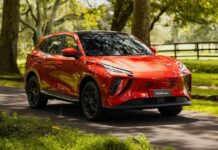
However, a shift is occurring. As buyers become more pragmatic, the definition of luxury is moving away from expensive badges and toward real-world value. In this evolving landscape, the Mazda CX-5 has emerged as a surprising heavyweight, quietly delivering a level of long-term satisfaction that rivals much more expensive luxury models.
Engineering Over Complexity: The Secret to Longevity
While many manufacturers are racing to implement complex hybrid systems, tiny turbocharged engines, and high-tech transmissions, Mazda has taken a different path with the CX-5. The brand has focused on refinement through proven technology.
The CX-5 offers two reliable powertrain options:
– A standard 2.5-liter four-cylinder (187 hp).
– A turbocharged version for those seeking more power (up to 256 hp).
Crucially, Mazda continues to use a six-speed automatic transmission. In an era dominated by Continuously Variable Transmissions (CVTs)—which can sometimes feel artificial or less durable—the traditional six-speed provides a predictable, engaging, and mechanically robust driving experience. By avoiding “over-engineering,” Mazda has created a vehicle that is inherently easier and cheaper to maintain over a decade of use.
A Cabin That Challenges the Luxury Segment
The CX-5 doesn’t just drive well; it feels premium. Mazda has invested heavily in the “sensory” aspects of ownership that often define luxury brands:
- Material Quality: The use of soft-touch surfaces and available leather upholstery elevates the cabin above the typical “plastic-heavy” mainstream SUV.
- Acoustic Comfort: Significant improvements in noise insulation mean the CX-5 offers a quiet, serene environment, effectively masking road and wind noise.
- Intuitive Design: Unlike many luxury vehicles that overwhelm drivers with complex touchscreens, Mazda utilizes a driver-focused layout with a rotary dial and physical buttons. This ensures that usability is never sacrificed for aesthetics.
“Accurate steering with good feedback, confident roadholding and resolute braking all harmonize to endow the little crossover with the road manners of a compact sports sedan.” — Lyndon Conrad Bell, TopSpeed Journalist
The Data: Reliability and Cost of Ownership
The decision to stick with proven mechanicals translates directly into impressive ownership metrics. Data suggests that the CX-5 is built to last, making it a smart financial move for long-term owners.
Key Reliability & Cost Stats:
- Expected Lifespan: Approximately 14.1 years or 164,000 miles, with a significant chance of reaching the 200,000-mile mark.
- Maintenance Costs: Estimates place annual repair costs at just $447 (via RepairPal), with a projected 10-year maintenance total of roughly $7,906 (via CarEdge)—outperforming the industry average.
- Reliability Ratings: The model consistently earns “great” scores from J.D. Power and maintains a high reliability rating of 7.9/10 from iSeeCars.
Why This Matters for Today’s Buyer
The success of the CX-5 highlights a broader trend in the automotive market: the democratization of premium experiences.
Modern consumers are increasingly prioritizing “Total Cost of Ownership” (TCO) alongside daily enjoyment. They want a vehicle that feels special every time they sit in the driver’s seat, but they also want to know that a major repair won’t bankrupt them in year seven. The CX-5 bridges this gap by offering the “emotional” benefits of a luxury car—style, quietness, and driving dynamics—without the “financial” penalties of a luxury brand.
Conclusion: The Mazda CX-5 proves that a luxury badge is no longer a prerequisite for a premium ownership experience. By prioritizing mechanical simplicity and interior refinement, Mazda has created a vehicle that competes directly with the best in the business on both performance and long-term value.