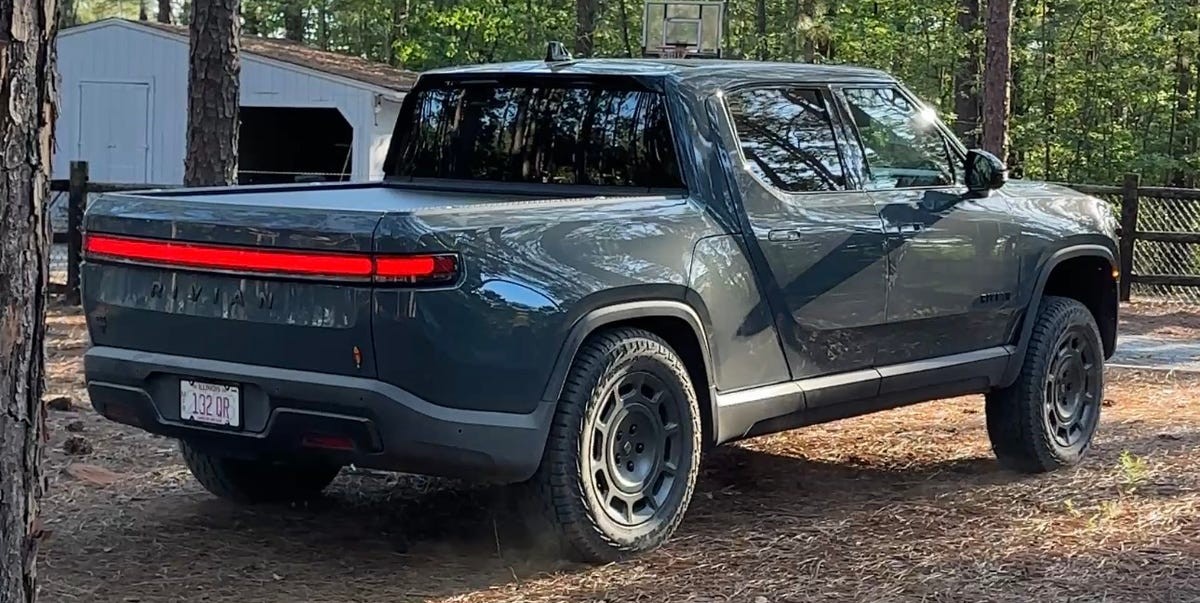
The Rivian R1T is designed with sophisticated engineering meant to provide precision, stability, and utility. Through its RAD Tuner menu, owners can fine-tune chassis settings and drive modes—adjustments typically handled by professional engineers to optimize performance. However, as with many highly programmable vehicles, users are finding ways to repurpose these pragmatic features for purely aesthetic, if unconventional, purposes.
What is the “Carolina Squat”?
To understand this trend, one must look at a specific automotive subculture. The “Carolina squat” refers to a visual modification where a truck’s front end is lifted high while the rear end is lowered. The result is a vehicle that looks as though it is perpetually under a heavy load or mid-impact after a jump.
While visually striking to some, the trend has faced significant legal pushback. In states like North Carolina, law enforcement has cracked down on “squatted” vehicles, citing safety concerns regarding visibility and handling. To circumvent these laws, many enthusiasts have turned to air-suspension systems, allowing them to maintain a level stance while driving to avoid tickets, only “squatting” the truck once it is parked.
The Rivian “Hack”
Rivian’s advanced air suspension, intended for serious utility, provides a built-in method to replicate this look without aftermarket modifications. The key lies in the vehicle’s Camp Mode.
The standard purpose of Camp Mode is to use the adjustable air springs to level the vehicle on uneven terrain, ensuring a flat surface for sleeping or camping. However, by manipulating the environment, a user can “trick” the system:
- Find an incline: Park the vehicle on a steep hill with the rear end higher than the front.
- Engage Camp Mode: Select the “level truck” option from the menu.
- The Result: The vehicle’s computer attempts to compensate for the slope by jacking up the front and lowering the rear to create a level platform. Because the truck is parked on an incline, the “level” position results in a pronounced, aggressive squat.
Engineering vs. User Intent
This phenomenon highlights a growing trend in the automotive world: the tension between intended utility and creative misuse. Rivian has built a highly adaptable platform capable of complex terrain management, but that same adaptability allows users to bypass the intended use cases.
While a “squatted” R1T is impractical—making driving difficult due to the extreme angle of the hood—the ability to achieve this look via software demonstrates just how much control modern drivers have over their vehicle’s physical stance.
As software-defined vehicles become the norm, the boundary between a manufacturer’s intended function and a user’s customized experience continues to blur.
Conclusion
By repurposing the Camp Mode leveling feature on an incline, Rivian owners can replicate the controversial “Carolina squat” aesthetic without any hardware changes. This serves as a reminder that even the most sophisticated engineering can be redirected by users to serve unconventional, purely visual goals.