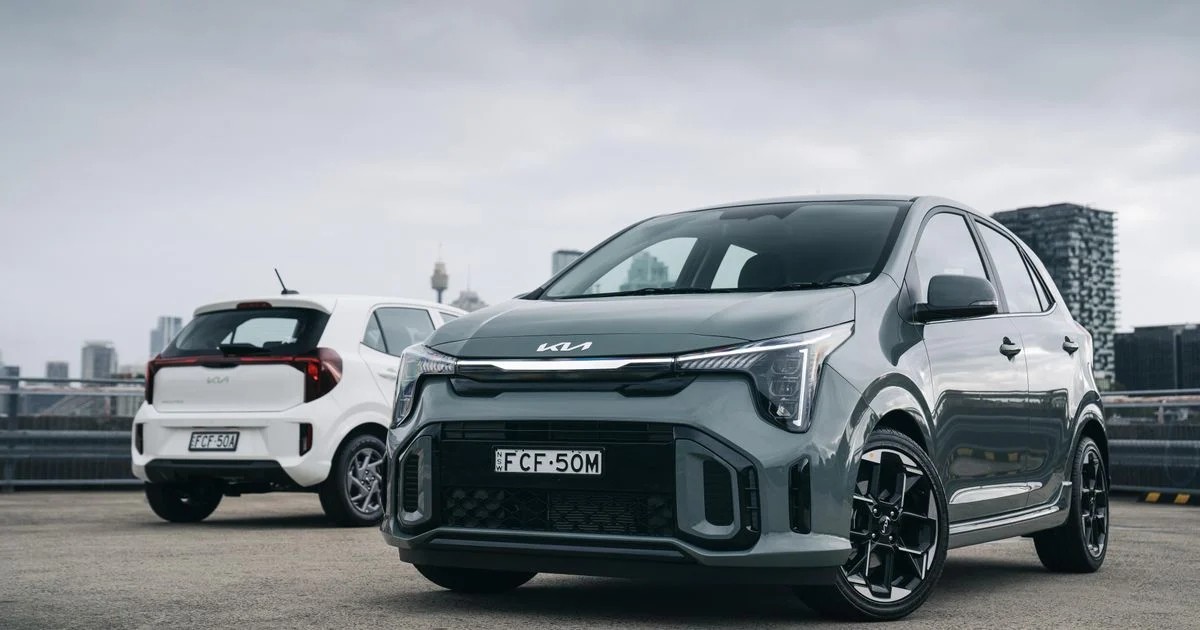
Kia Australia has confirmed that the popular Picanto city car will continue to be sold in the country for “many years,” despite growing pressure to reduce carbon emissions and an increasing shift towards electric vehicles. Roland Rivero, Kia Australia’s general manager for product planning, stated the company has no plans to discontinue the model, unlike its New Zealand counterpart. The Picanto remains a vital entry point into the brand for Australian consumers.
Dominating the Micro Car Segment
The Picanto currently dominates the Australian micro car segment, holding a 94.6% market share as of 2023. When including the broader light passenger car segment, it ranks second only to the MG 3 in sales volume (7,166 units versus 8,350 units), experiencing a 23.1% growth in the last calendar year. This strong demand ensures its continued presence in the lineup.
Navigating New Vehicle Efficiency Standards (NVES)
Kia Australia acknowledges the challenges posed by the incoming New Vehicle Efficiency Standards (NVES). The company is evaluating all powertrains, including the Picanto’s, to ensure compliance. While future adjustments may be necessary to lower the brand’s overall carbon footprint, the Picanto’s immediate future remains secure due to its sustained popularity.
Australian vs. International Specs
The Australian Picanto is currently powered by a 1.25-liter four-cylinder engine, while European models have transitioned to a more efficient 1.0-liter engine with direct injection. Australian models produce 62kW/122Nm, while the Euro-spec engine delivers 50kW/96Nm. Despite this difference, the Australian Picanto maintains competitive fuel efficiency at 4.6-5.1L/100km. Emissions are rated between 125-140g/km under ADR testing. The more stringent WLTP cycle used in Europe shows the 1.0-liter engine achieving better results at 122-132g/km.
Future Electrification Plans
Kia is exploring a fully electric city car, internally dubbed ‘EV1’, to replace the Picanto in the long term. The company already offers a similar model – the Ray – exclusively in Korea. However, the development and launch of a global EV equivalent are still years away. Regulatory changes and emission standards may prolong the availability of combustion-engine Picantos even further.
The Picanto’s success in Australia stems from its affordability, starting at $19,190 (plus on-road costs), making it one of the cheapest new cars available. The model is offered in Sport and GT-Line trims, with both manual and automatic transmission options.
The Picanto’s continued presence demonstrates the enduring demand for affordable and efficient vehicles in the Australian market, even as the automotive industry shifts towards electrification.