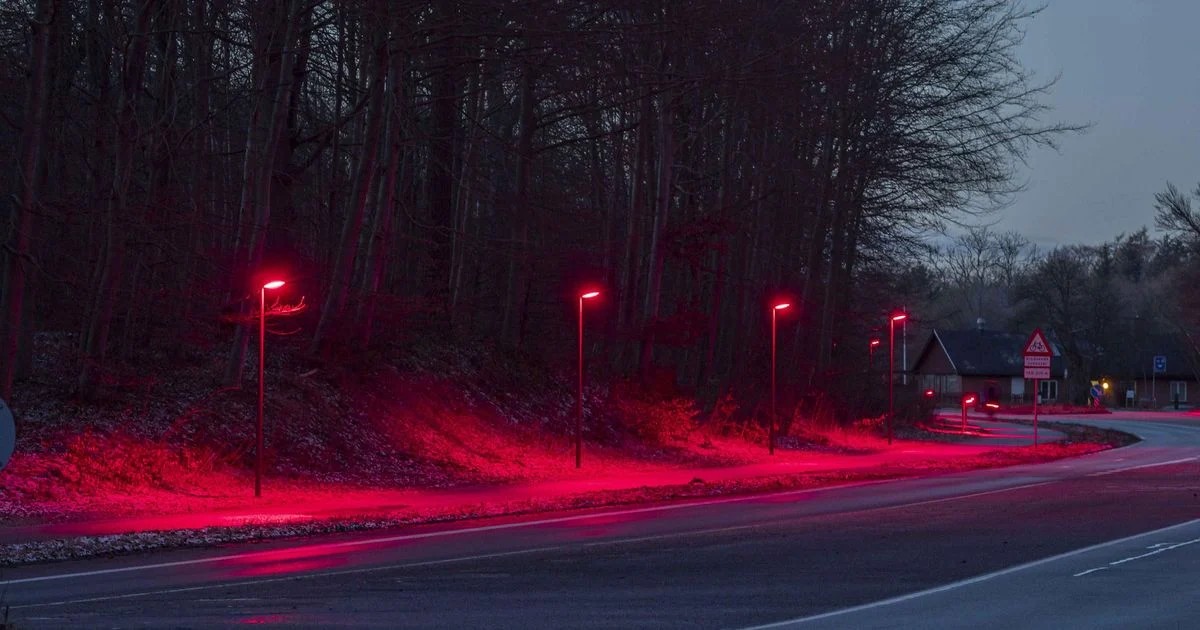
Denmark is switching to red street lighting in certain areas, marking a significant step toward mitigating light pollution’s impact on wildlife while simultaneously testing cutting-edge smart city technologies. The city of Gladsaxe, near Copenhagen, is leading the initiative by installing approximately 5,000 red LED street lights, particularly along routes frequented by seven species of bats.
Why Red? The Science Behind the Shift
Traditional white and blue-spectrum lights disrupt bats’ natural echolocation abilities, hindering their foraging and breeding behaviors. The Danish Road Directorate (DRD) research revealed this disruption, prompting the move to red LEDs. Red light, with its longer wavelengths, interferes far less with bat navigation and daily life. This isn’t just about bats; it’s about the broader impact of artificial light on ecosystems.
The switch also offers practical benefits: red LEDs consume less energy than older sodium lights and require reduced maintenance. Their brightness is adjustable, allowing for optimal road safety without excessive light spill.
Smart Lighting: More Than Just Illumination
The project extends beyond wildlife protection. These new lights incorporate motion sensors, marking an early stage in integrating street infrastructure with intelligent systems. Dutch company Signify envisions a future where streetlights function as “digital nodes” – connected devices with IP addresses, capable of hosting 5G, Wi-Fi, CCTV, and even noise-detection microphones.
“The streetlight has come of age… providing quality lighting, but also as a digital node,” says Signify spokesperson Harry Verhaar.
This interconnectedness could yield valuable data on traffic patterns, electricity usage, and noise pollution, allowing cities to adapt lighting levels based on real-time activity. The implications are vast: from optimized energy consumption to enhanced public safety and data-driven urban planning.
European Initiative and Global Trends
The Danish project is part-funded by the EU’s ‘Lighting Metropolis – Green Mobility’ program, which has already replaced 50,000 older streetlights across Denmark and Sweden. Meanwhile, Australia is transitioning to white LEDs, with trials of dimmable warm-white options underway in Victoria.
The trend is clear: cities worldwide are moving towards more efficient, data-rich lighting systems. The question isn’t if streetlights will become smart, but how quickly and how effectively their potential will be unlocked.
The adoption of red LEDs in Denmark represents a pivotal moment in this evolution, showcasing how environmental concerns and technological innovation can converge to reshape urban infrastructure.