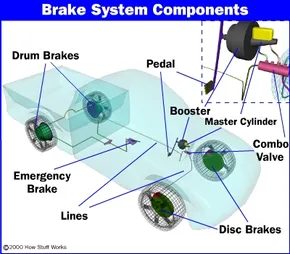
You know the drill. Foot meets pedal. Car stops. It feels instantaneous, almost magical, but it is purely mechanical. The real question isn’t just that it works. It is how. How does a human leg, capable of modest effort, generate enough force to halt a metal box weighing thousands of pounds?
The answer lies in transmission and multiplication. Your foot pushes a lever. That lever moves fluid. That fluid pushes pistons. Simple, right? Wrong. The system relies on two distinct physics concepts to bridge the gap between your calf and your brake pads: leverage and hydraulics.
Without these, you would need the strength of a bodybuilder to stop a sedan. The brakes themselves use friction to grab the rotors. The tires use friction to grip the asphalt. But before we dive into calipers and lines, we need to look at the underlying principles. Specifically, leverage and hydraulics. These are the engines of your braking power.
The Physics Behind the Stop
To understand the mechanics, you have to respect the physics. Three pillars support the entire braking architecture: leverage, hydraulics, and friction. We will break down the first two here. Friction is the result, not the driver.
Leverage is the easiest concept to grasp. Think of a crowbar. A long bar allows you to lift a heavy object with minimal effort. Your brake pedal operates on the same principle. It is a lever.
When you press the pedal, you are applying force at one end. The pivot point, or fulcrum, is located closer to the master cylinder. This creates a mechanical advantage. You might press down with 50 pounds of force. The geometry of the pedal ensures that the master cylinder piston receives significantly more than that. The ratio varies by vehicle, but the effect is consistent. Your leg force is amplified before it even touches the brake fluid.
Hydraulics take that amplified force and multiply it further. Brake fluid is incompressible. This is the key property. When you push fluid in one end of a sealed system, the pressure travels instantly to the other end.
Pascal’s Law dictates this behavior. Pressure applied to a confined fluid is transmitted equally in all directions. But here is where the multiplication happens. The master cylinder has a small surface area. The wheel cylinders (or calipers) have larger surface areas.
Force equals pressure times area. If the pressure is constant throughout the system, a larger area results in greater force. The small piston in the master cylinder pushes fluid. That fluid pushes against a larger piston at the wheel. The force multiplies. You might start with 200 pounds of input. The caliper piston could be pushing with 800 pounds or more, depending on the ratio.
This hydraulic multiplication is essential. Without it, the friction required to stop the car would be impossible to achieve by foot alone. The system acts as a force multiplier, turning modest human effort into substantial stopping power.
The tires then translate this hydraulic force into actual deceleration. Friction between the pad and rotor slows the wheel. Friction between the tire and road slows the car. But the magic starts with the lever and the fluid.
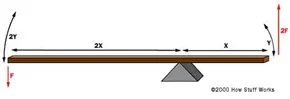
Levers are the original force multipliers. You push down on a long arm, and the short arm lifts a heavy load with double the power, though half the travel. Hydraulics work on the same trade-off. You sacrifice distance to gain torque.
The secret ingredient is incompressibility. Unlike air, which squishes under pressure, brake fluid refuses to compress. This property allows a force applied at one point to transmit directly to another point through a medium that doesn’t lose energy to deformation. In most automotive brake systems, that medium is oil.
The physics of fluid transfer
Imagine two glass cylinders plugged with pistons, filled with oil, and connected by a flexible hose. Push one piston down. The oil has nowhere to go but up the other side. Because the fluid is incompressible, nearly 100% of the input force reaches the second piston.
This setup is robust. The connecting pipe doesn’t need to be straight. It can snake through the chassis, bend around suspension components, or twist under torque without losing efficiency. The pipe can also branch, allowing a single master cylinder to drive multiple slave cylinders. One pump, four wheels. Simple.
Calculating hydraulic multiplication
Force multiplication isn’t magic. It’s geometry. Specifically, it’s the ratio of piston surface areas.
Consider a master cylinder with a 2-inch diameter piston and a slave cylinder with a 6-inch diameter piston.
- Left piston radius: 1 inch
- Right piston radius: 3 inches
Area equals pi times radius squared ($\pi r^2$).
- Left area: $\pi \times 1^2 \approx 3.14$ square inches
- Right area: $\pi \times 3^2 \approx 28.26$ square inches
The right piston is nine times larger than the left. This 9:1 ratio dictates everything. Apply 100 pounds of force to the small piston, and the large piston exerts 900 pounds.
But there is a catch. Conservation of energy still applies. To raise the 900-pound load by 1 inch, you must push the 100-pound piston down 9 inches. You trade travel for torque. This is why brake pedals have long leverage arms before they even touch the master cylinder. The hydraulic system does the rest.
Friction

Understanding Friction Through Mass
Friction is basically the resistance you feel when trying to slide one surface across another. Look at the setup. Two blocks. Same material. One is significantly heavier.
You don’t need a physics degree to guess which one the bulldozer will struggle to move. The heavier block wins. But why?
Let’s zoom in. Take a close look at that single block and the table beneath it.
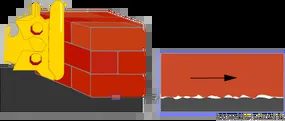
The surface of a block might look flat, but up close, it’s a landscape of peaks and valleys. When you place that block on a table, those microscopic high points crash into each other. Some actually weld together under pressure. Heavier blocks press down harder, squeezing the surfaces tighter and making them harder to slide.
Different materials resist movement differently. Sliding rubber against rubber is tougher than sliding steel against steel. This resistance is defined by the coefficient of friction. It is the ratio of sliding force to the object’s weight.
If the coefficient is 1.0, a 100-pound block requires 100 pounds of force to move. A 400-pound block needs 400 pounds. If the coefficient drops to 0.1, the same 100-pound block only needs 10 pounds of force. The 400-pound block needs 40 pounds.
The force required to move an object scales directly with its weight. This principle drives brakes and clutches. A pad presses against a spinning disc. More pressure equals greater stopping power.
Static vs. Dynamic Friction
Breaking an object loose takes more force than keeping it moving. When surfaces are stationary relative to each other, static friction is at play. Once they slide, dynamic friction takes over. Dynamic friction is usually lower.
Car tires rely on this distinction. Tires provide maximum traction when the contact patch is gripping the road, not sliding. Skidding or burning rubber reduces traction significantly. The car loses grip the moment it moves into dynamic friction territory.
Hydraulic Force Multiplication
Consider a simple brake setup. The distance from the pedal to the pivot is four times the distance from the cylinder to the pivot. This leverage increases pedal force by four times before it hits the cylinder.
Next, the brake cylinder diameter is three times wider than the pedal cylinder. This multiplies force by nine. Combine the leverage and the cylinder size, and you get a 36x force multiplier.
Put 10 pounds on the pedal. The wheel receives 360 pounds of pressure on the brake pads.
The Leak Problem
This simple system has a flaw: leaks. A slow leak drains fluid until there isn’t enough to fill the cylinder. The brakes fail gradually. A major leak is worse. Apply the brakes once, and all fluid squirts out. Complete failure happens instantly.
Modern master cylinders solve these issues. They include safety features to prevent total loss of pressure. Understanding how they work requires looking at combination valves and hydraulic principles. The next steps in this series cover drum brakes, disc brakes, power brakes, and anti-lock systems.