Preston Tucker didn’t just walk into a room; he occupied it. At six feet tall and 200 pounds of pure ambition, he was a salesman who had already rubbed shoulders with giants like Studebaker and Dodge before striking out on his own. By 1935, he was busy securing cash from Henry Ford to build race cars for Indianapolis. Two years later, he was engineering high-speed military scouts for the war effort. But none of that prepared the auto world for 1948. That’s when Tucker unveiled what he boldly claimed was “The Most Completely New Car in Fifty Years.”
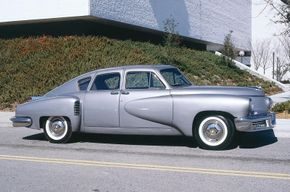
It wasn’t just marketing fluff. The Tucker 48 looked nothing like the bulbous, tail-finned monsters clogging Detroit streets. Styled by Alex Tremulis, the Tucker Torpedo was a torpedo-shaped fastback four-door sedan that looked less like a car and more like a sci-fi prop. It sat on a 128-inch wheelbase but stretched 219 inches long, while its profile hunkered down to a mere 60 inches high. War-weary Americans had been dreaming of a future vehicle for years. Tucker gave them one.
Engineering That Defied Convention
Detroit engineers would have had heart attacks looking at the Tucker 48 chassis. It ditched the traditional solid rear axle for all-independent suspension. The engine? A rear-mounted flat-six derived from a wartime helicopter unit. It was air-cooled in design but featured a fully sealed water-cooling system—an industry first.
The specs were staggering for the era. A 335 cubic inch, all-alloy powerplant pushed out 166 horsepower and a thumping 372 pound-feet of torque. Yet, it weighed only 320 pounds. It was bolted to a sturdy box-section perimeter chassis with subframes at each end.
The rear-engine layout, combined with all-independent suspension and center-point steering, created surprisingly easy handling and secure roadholding for a car that weighed 4,200 pounds.
Innovations Ahead of Their Time
Tucker had bigger ideas. He wanted curved windshields, disc brakes, and “Torsilastic” rubber springs. Time and money, along with a lack of available technology, killed those specific features. But the Tucker 48 still packed enough novelties to make it a rolling laboratory.
There was the central “cyclops-eye” headlight that turned with the front wheels, cutting through fog better than any standard setup. The roof featured suicide-style doors cut directly into the frame for easy entry and exit. Inside, a “step-down” floor created a roomy cabin for six passengers. The front and rear seats were interchangeable, a clever trick to even out upholstery wear over time.
Safety was the selling point. Massive bumpers protected the ends. All interior knobs, buttons, and levers were recessed or protected so they wouldn’t jab occupants during a crash. The windshield glass was designed to pop out harmlessly on impact. And then there was the “Safety Chamber,” a padded area in the floor where front passengers could dive if they sensed an impending collision.
Performance That Silenced Critics
Despite the heavy 4,200-pound curb weight, the Tucker 48 wasn’t a boat. Factory tests showed it could sprint from 0-60 mph in about 10 seconds. Top speed sat at a respectable 120 mph, aided by aerodynamic styling with an estimated drag factor of 0.30. That figure remains competitive by today’s standards.
Fuel economy was equally impressive. At a steady 50-55 mph, the Tucker returned a creditable 20 mpg. It handled like a much lighter car. Why? The rear-engine layout kept the center of gravity low and planted. The all-independent suspension kept all four tires glued to the road. It was engineering precision wrapped in a package Detroit couldn’t comprehend.
The $4,000 Price Tag That Killed It
Preston Tucker had a problem. He wanted to sell a car that rivaled a Cadillac but priced it at roughly $4,000. That was aggressive. Too aggressive for the established order.
Production ended with just 50 cars. Plus one prototype known as the “Tin Goose.” All were built before August 1948. The last 37 rolled off a short assembly line in a refurbished wartime Dodge plant on Chicago’s South Side.
Tucker claimed the car was too good to live. Evidence suggests the Detroit establishment felt threatened. But Tucker also doomed his own venture. He moved with suspicious haste to issue $15 million in stock to finance production. The SEC smelled blood. They probed the “fast-sell” tactics, generating a wave of adverse publicity.
In October 1949, Tucker and seven associates faced trial on 31 counts of conspiracy, securities fraud, and mail fraud. It was a circus. The jury acquitted them all in January 1950, calling the proceeding a farce. But the damage was done. Tucker Corporation still had funds. Receivers briefly considered finishing the cars. Instead, they auctioned everything off at 18 cents on the dollar. The dream was dead.
Aftermath and Legacy
Alex Tremulis didn’t stop. He sketched a stunning fastback coupe called the Talisman as a proposed 1950s successor. Preston Tucker, even after the Chicago ordeal, refused to quit. He moved to Brazil, planning a two-seat kit sports car called the Carioca. He died on December 26, 1956, at just 53 years old. Broken, but still building.
Francis Ford Coppola later turned the saga into the 1988 film Tucker: The Man and His Dream. It’s good drama. But Coppola plays fast and loose with facts, much like Preston did. The famous closing parade sequence shows almost every Tucker built, including two owned by Coppola. But those cars never made a triumphant procession after the verdict in unpredictable Chicago spring weather. And the scene where Tuckers get smashed? Those were replicas.
The real story is quieter. Just 50 cars. A dream crushed by bureaucracy, jealousy, and poor timing. But in the world of defunct American automotive history, the Tucker 48 remains a legend. Not for what it sold, but for what it proved was possible.
For more on other lost American marques, explore the histories of AMC, Duesenberg, Oldsmobile, Plymouth, and Studebaker.