
Nearly every living thing on this planet runs on solar power. The mechanism is straightforward: plants turn sunlight into chemical energy. Animals eat the plants. Humans eat the animals or the plants. We burn wood, coal, or processed crops to get heat. Petroleum is just ancient biomass that fossilized over millions of years. Even first-generation biofuels come from corn, sugar cane, or vegetable oil. It is a closed loop.
The loop is broken.
Petroleum is messy. It creates geopolitical instability. It pollutes. First-generation biofuels are not carbon neutral. They require burning other fuels to refine. The bigger issue is land use. When you turn food crops into fuel, supply drops. Prices spike. Hunger increases. Political tension follows.
Is there a better way?
Researchers are looking at a different angle. They want energy from crops without killing them. They want to use land that isn’t suitable for food. They want microbes to do the heavy lifting. This is the core concept behind plant-microbial fuel cells.
Plants get the spotlight. Microbes get the blame. Both are essential. Cyanobacteria form the base of the food chain. Gut microbes help us digest. Soil bacteria recycle waste into nutrients for plants. For decades, scientists studied this microbial metabolism. They wanted to harvest the energy.
By the 1970s, they had a prototype.
These early devices were called microbial fuel cells. They generate electricity through chemical reactions driven by microbes. The output is low power. But it is renewable. MFCs can monitor pollutants. They can help clean water. They can desalinate. They can power remote sensors.
There is a limitation.
MFCs need food. Usually, that food is organic waste in wastewater. The researchers realized something simple. Plants excrete sugars into the soil. This is waste from the plant’s perspective. It is fuel for the soil microbes. It is an endless, solar-powered buffet. Why collect the waste when you can just plug into the living root?
The idea took hold.
By 2008, papers started appearing. The first plant-powered MFCs were announced. The potential was clear. The technology is scalable. In developing regions, villages could become self-sufficient. Farms could power themselves. In industrialized nations, we could reduce our carbon footprint. We could draw power from wetlands. We could use greenhouses. We could integrate them into biorefineries.
It sounds too good to be true.
But it is just a new spin on an old idea. These are plant-microbial fuel cells. They are green. They are quiet. They are just getting started.
The Chemistry of Living Power
You might think electricity needs wires and grids, but nature has been running its own micro-power plants under our feet for eons. It’s not magic. It’s just biology with an electrical twist.
Plants are busy photosynthesis machines. They take sunlight, turn it into chemical energy, and store it as sugars. But they don’t keep it all. They exude waste through their roots into the rhizosphere. That’s the zone of soil directly influenced by root secretions. Bacteria live there. They eat the sugars and proteins the plant spits out.
This relationship is the engine of a Plant Microbial Fuel Cell (PMFC). The plant provides the fuel. The bacteria provide the mechanism. As long as the sun shines and the plant stays green, the bacteria have a meal ticket. And that meal generates electricity.
Yes, the first law of thermodynamics still applies. You can’t get energy from nothing. The sun is the external source. But the conversion happens right there in the dirt.
How Microbes Turn Food into Current
So how does eating sugar create a spark? It’s chemistry. Specifically, it’s about splitting a reaction in half.
In a standard combustion or respiration model, glucose and oxygen react to produce carbon dioxide and water. The equation looks clean:
C6H12O6 + 6O2 → 6CO2 + 6H2O
But cells don’t do that in one big leap. They break it down into steps. Some of those intermediate steps release electrons. Electrons are what we need for current.
Instead of the full reaction, the microbial process splits like this:
C6H12O6 + 6H2O → 6CO2 + 24H+ + 24e-
Notice the electrons (e-) on the right side? Those are the free agents. They want to go somewhere. They want to combine with oxygen.
This split defines the two halves of the fuel cell.
The first half happens in the rhizosphere. It’s dark, wet, and full of bacteria breaking down root exudates. The plant roots, the waste, and the microbes share this space.
The second half is on the other side of a permeable membrane. In nature, that membrane is the boundary between soil and water. It’s oxygen-rich there.
The Circuit is Closed
Here is where the magic happens. The protons (H+) and electrons (e-) from the first half need to meet oxygen to complete the reaction.
In the second chamber, they combine with oxygen to make water:
6O2 + 24H+ + 24e- → 12H2O
The protons flow across the ion exchange membrane. This creates a net positive charge. The electrons? They can’t cross the membrane. So they take the long way around. They flow through an external wire to get to the oxygen side.
That flow is current. Voila. You just powered something using plant waste.
Rooting Out Potential Problems
It sounds perfect. Clean energy. No moving parts. But there are problems.
We don’t fully understand how electrodes affect the root environment. Insert metal probes into soil changes everything. It could reduce nutrient availability. It might weaken a plant’s immune system. If the plant dies, the fuel cell stops.
Then there’s the location issue. PMFCs work best in wetlands and croplands. These are protected lands. Environmental approval for installing electrodes in protected wetlands is going to be a legal nightmare.
However, there’s a potential upside. Microbial fuel cells in wastewater can oxidize ammonium and reduce nitrates. Agricultural runoff is a huge problem for wetlands. If PMFCs can help clean that water while generating power, they might offset the environmental risk.
It’s a trade-off. We’re looking at a technology that could heal the land while powering it. But we need to know exactly what those electrodes are doing to the roots before we plant them everywhere.
The science is solid. The engineering is messy. The future is muddy.
The Limits of Green Electricity
Look at a PMFC setup in 2012. It looks like a garden. Specifically, a wetland garden. Reed mannagrass, rice, cordgrass, or giant reed grow in the soil. Colorful wires trail out of the dirt. That’s the only clue that energy is being generated.
They don’t produce much power. Not yet. They only work in water.
But the science is moving. Researchers are driven by a bigger problem: the food-energy conflict. Biofuels strain the global food supply. PMFCs offer a way out. They don’t require draining rice paddies. Farmers can keep growing food. Villages can install these systems in wetlands. Poor soil areas can generate power without stealing arable land.
Greenhouses could run them year-round. Open fields? That depends on the season.
Local energy reduces the need to ship fuel. Less shipping means fewer carbon emissions. It sounds like a win.
There is a bottleneck. A big one. The plant itself.
Photosynthesis is inefficient. Chloroplasts only absorb light in the 400-700 nanometer range. That’s 45 percent of solar radiation. The rest bounces off. Plants waste the rest.
C3 and C4 plants handle this differently. C3 plants form three-carbon molecules first. They make up 95 percent of species. Trees, wheat, rice. Their theoretical efficiency caps at 4.6 percent. In reality, they hit 70 percent of that. About 3.2 percent.
C4 plants? Corn. Sugarcane. They form four-carbon molecules. They are better. Theoretical limit: 6 percent. Practical limit: around 4.2 percent.
Then comes the soil. Only 20 percent of plant biomass reaches the root zone. The rhizosphere. From there, only 30 percent becomes food for microbes. The microbes do their job. They spit out electrons.
PMFCs capture 9 percent of that microbial energy as electricity.
Do the math.
For C3 plants: 0.70 x 0.046 x 0.20 x 0.30 x 0.09.
Result: 0.017 percent solar-to-electric conversion.
For C4 plants: 0.70 x 0.060 x 0.20 x 0.30 x 0.09.
Result: 0.022 percent.
Tiny numbers. But some researchers think these models are too pessimistic. If the potential is higher, consumers win.
Hydrogen Hope
Fuel cells are gaining traction. They give cars more range than batteries. They fit large vehicles better. Interest surged in late 2012.
Hydrogen fuel cells seem green. They aren’t. Making hydrogen takes massive amounts of electricity. The process isn’t carbon-neutral. It defeats the purpose.
PMFCs produce hydrogen gas naturally. Through the same microbial process that generates electricity. This could be the key to true green hydrogen production.
From Petroleum to Plowshares
The shift from oil to plants isn’t just about fuel. It’s about land use. It’s about stopping the competition between food and energy. Wetlands become power plants. Rice paddies become hybrid systems. The soil works harder. The grid gets cleaner.
The efficiency is low. The technology is young. But the alternative—digging up the earth for oil—feels increasingly obsolete. The roots are ready.
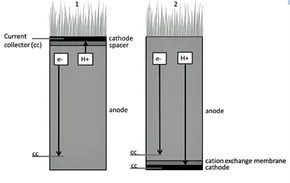
The technology isn’t flawless. Plant Microbial Fuel Cells (PMFCs) are stuck in a tug-of-war. The substrate needs to support plant roots while simultaneously facilitating electron transfer. These two goals often fight each other. Take pH levels. If the acidity differs between the two cell chambers, ions rush across the membrane to balance things out. This short-circuits the voltage. The electrical potential drops. Engineers have to solve this.
Fix the kinks, and the potential is staggering. It all depends on energy density. A 2008 study pegged the output at 21 gigajoules per hectare annually. That’s 5,800 kilowatt-hours per 2.5 acres. Newer data suggests that number could skyrocket to 1,000 gigajoules per hectare.
To put that in perspective, consider the baseline:
– A single barrel of oil holds about 6 gigajoules of chemical energy.
– Europe has 13.7 million farmers. Average farm size is 12 hectares.
– The U.S. has 2 million farmers. Average farm size is 180 hectares.
Run the numbers. If just 1 percent of U.S. and European farmland switched to plant microbial fuel cell technology, the yield would be massive. Europe could generate 34.5 million gigajoules annually. The U.S. could hit 75.6 million gigajoules.
Compare that to consumption. In 2010, the 27 EU nations burned through 1,759 million tons of oil equivalent (TOE). That equals 74.2 billion gigajoules. Or 20.5 trillion kilowatt-hours. TOE is the standard metric for comparing energy sources. One ton of oil equivalent.
In this simplified model, PMFCs are a drop in the bucket. A huge drop, but still a drop compared to total demand. Yet it’s a pollution-free drop. It comes from green fields, not smokestacks or wind turbines killing birds.
This is just the start. Researchers are engineering bacteria that eat waste faster. Between 2008 and 2012, tweaks to substrate chemistry doubled electrical output in some tests. PlantPower, a key player in the field, claims perfected PMFCs could supply 20 percent of Europe’s primary energy. That’s power pulled directly from natural, untransformed sources.
Cost is still the barrier. They need to be cheaper and more efficient before widespread adoption. Progress is happening. Manufacturers are ditching precious metals for conductive carbon cloth electrodes. It saves money. In 2012, running a one-cubic-meter setup in a lab cost $70.
Think about the side benefits. Pollutant removal. Greenhouse gas reduction. If investors and governments see the value, PMFCs could become the power plants of the future. Or they might just plant the seed for something even better.