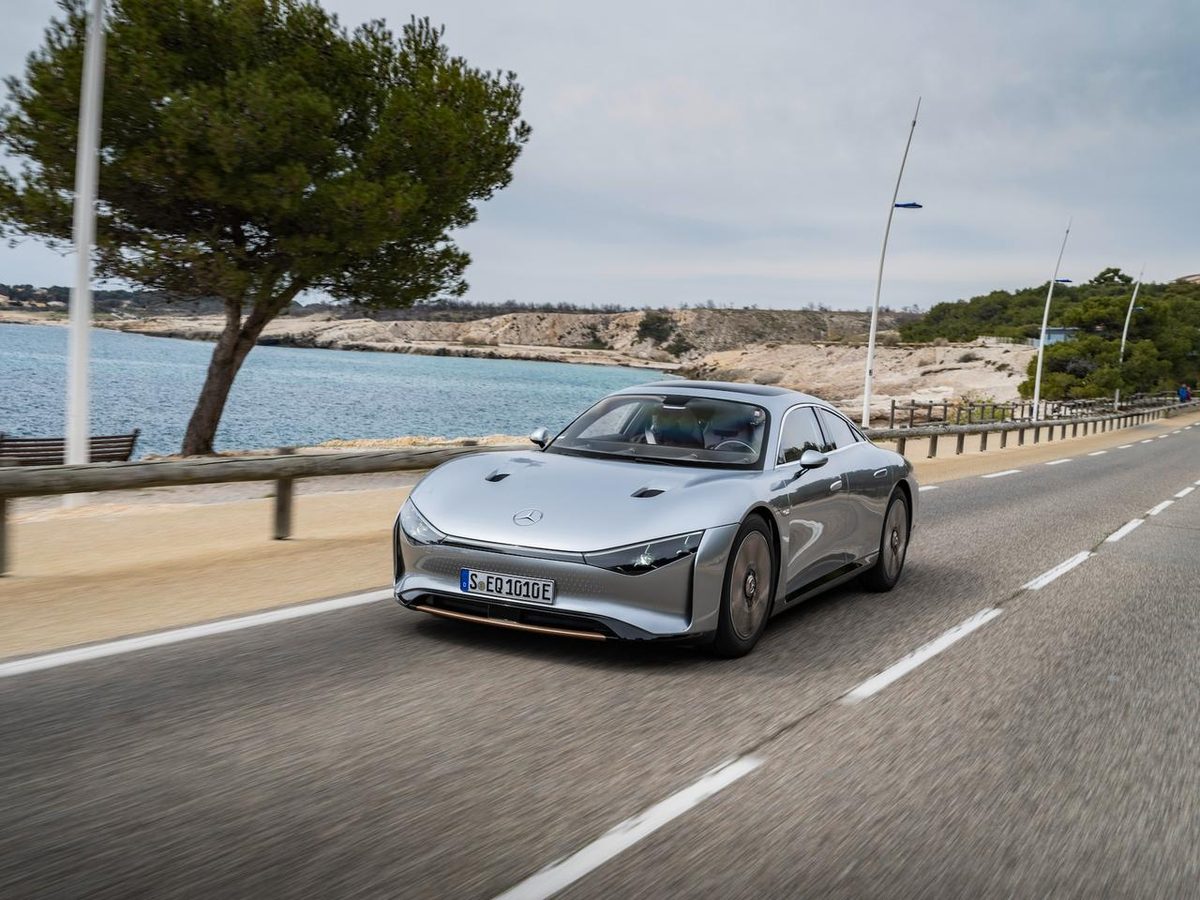
Mercedes-Benz takes action. The German luxury car giant isn’t just trying to make a comeback in the electric car race. They want to define it. The Vision EQXX prototype proves that range anxiety is becoming a thing of the past. This is not a theoretical project. This is reality on the road.
The mileage of the third main test run was exactly 1000 km. It never stopped. No charging breaks. Pure efficiency. result? The battery shows that there is still more than 300 km of operating range. This is not a typo. That is a massive margin for error.
How Mercedes achieved a range of 1,000 kilometers
Most electric cars struggle to reach 400 or 500 kilometers in real-world conditions. Mercedes flipped the script. Vision EQXX aims for a range of 1,000 kilometers. This test confirms that your goals are achievable.
Efficiency comes from three main things. Aerodynamics. battery chemistry. Powertrain optimization.
Perfect aerodynamics
The car looks like a teardrop on wheels. It’s not a matter of style. This is for physics. The drag coefficient reaches an astonishing 0.17. By the way, this is lower than most supercars. Less than many mainstream EVs. Air resistance affects range. The Vision EQXX slices through it.
Battery Efficiency
The battery pack uses silicon anode technology. This allows for a higher energy density. The total capacity is about 100 kWh. However, available capacity is more important. Mercedes optimizes every amp hour. Heat management is also important. The thermal system uses little energy to cool the battery. Less energy is used for cooling, more energy is spent on driving.
Why this matters for the future of electric vehicles
A range is more than just a number. It changes behavior. Drivers no longer have to worry about charging infrastructure. They drive longer distances. This reduces the load on the charging network. This provides grid stability.
Mercedes has established itself as a leader in autonomous electric driving. Vision EQXX is a proof of concept. This shows that traveling long distances is as easy as using a gas-powered car. Without the fuel stops.
Comparison with mainstream electric cars
| Features | Vision EQXX Prototype | Typical long distance electric vehicle |
|---|---|---|
| Target Range | 1000 km | 500-700km |
| Drag Coefficient | 0.17 | 0.22-0.25 |
| Battery technology | Silicon Anode | Standard Lithium-Ion |
| Weight | Very Low | Average/High |
Most electric cars focus on acceleration. Or luxury features. Mercedes is all about efficiency. Vision EQXX is a research project. However, the technology is slowly catching on, and future production models will likely see these efficiency improvements.
Where does Mercedes go next?
The third journey was not an anomaly. This is confirmation. Mercedes has the technology. They have engineering skills. Now they need to scale it.
The Range anxiety is real. But it is disappearing. Vision EQXX shows the way. 1000 km is not a dream. This is a benchmark. Other manufacturers must also respond. The race for electric efficiency just
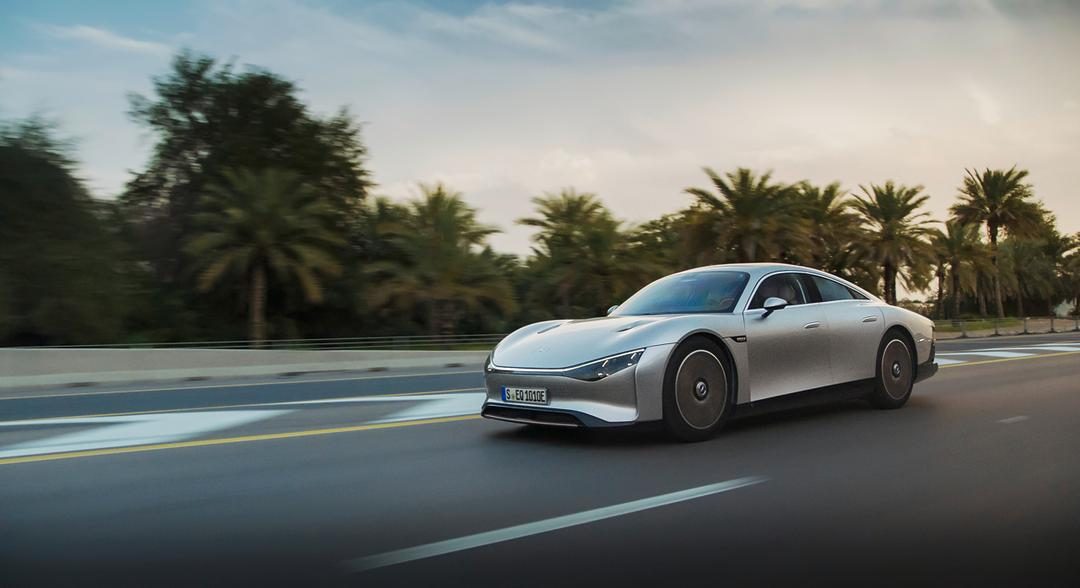
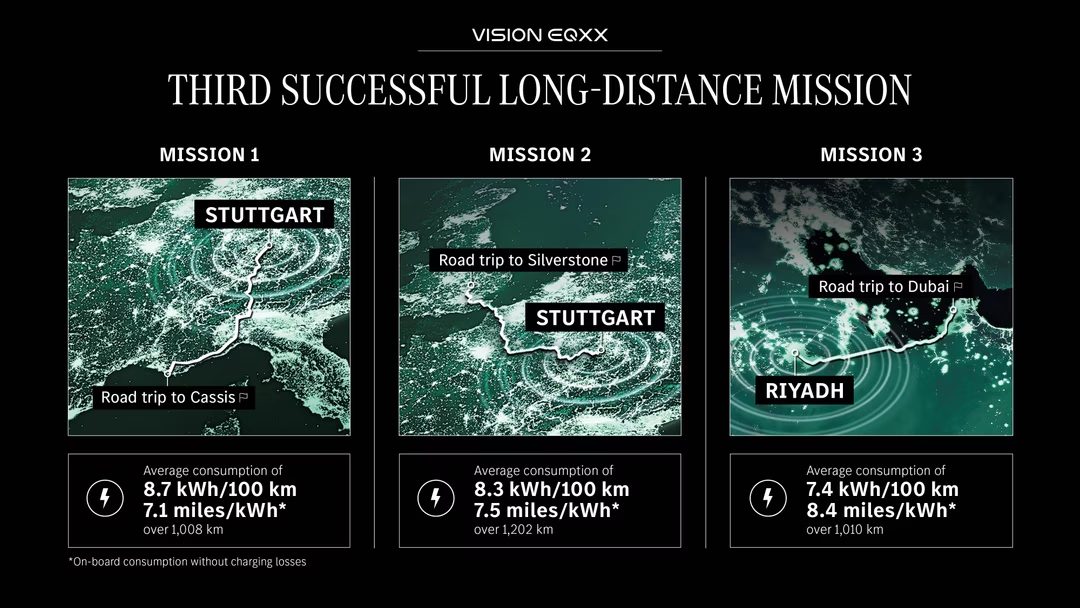
7.4 kWh/100 km: Desert Efficiency Benchmark
The numbers are astounding. It is 7.4 kWh/100 km. Even under perfect conditions, most EV owners struggle to keep energy consumption below 12 kWh on long trips. Would you do something like this in the heat of the Middle East? That’s a whole different beast.
The total length of the route is 1010 kilometers. Cut from urban sprawl to empty desert highways. The average speed remained stable at 79.4 km/h. Top speed is 140 km/h. The daytime temperature can rise to 34 degrees.
This is not just a test drive. This is a stress test of thermal management and aerodynamic efficiency.
Journey from Riyadh to Dubai
The third part of the journey starts at the Mercedes-Benz Center in Riyadh, Saudi Arabia. The finish line will be set at the Mercedes Center in Dubai. The total time is 14 hours and 42 minutes.
This includes 1 hour and 57 minutes of stopping time.
“Achieving 7.4 kWh per 100 kilometers in the desert is an impressive feat of engineering.”
The combination of operating conditions is important. Urban areas are inefficient due to stop-and-go traffic. However, you can drive at a steady speed in the open desert. The high average speed proves that the battery management system does not suffer from heat load.
Why this consumption matters
Hobbyists often mention the range anxiety as their main obstacle. These data suggest that the real problem may be efficiency at extreme loads.
Consider the alternatives. For Tesla Model Y drivers who drive long distances on the same route, numbers hovering near between 13 and 15 kWh per 100 kilometers. A Peugeot e-208 or a Volkswagen ID.3 would be even worse if you kept going at high speeds in the desert.
7.4 kWh figure defies standard expectations. This challenges the idea that electric cars are inherently less efficient than combustion engine cars at certain speeds and high temperatures.
Technical Implications
The key is the 140 km/h top speed. Air resistance is proportional to the square of the speed. At such speeds, energy consumption often increases exponentially.
Keeping consumption very low means:
1. Excellent aerodynamic design.
2. Highly efficient powertrain cooling.
3. Parasitic losses caused by air conditioning are minimal.
The air conditioner has to work overtime when the outside temperature is 34 degrees Celsius. However, the battery still delivered is still 7.4 kWh/100 km.
It’s not just marketing. This data point forces us to reevaluate how we evaluate the performance of electric vehicles. Deserts do not tolerate inefficiency. It reveals possible deficiencies in heat and energy management.
The gap between theoretical range and actual consumption is closing. Maybe you just made a mistake in your measurements before.
The journey continues. However, this part alone changes the basis of possibilities.
The third part of the Vision EQXX Endurance Run
Mercedes is not resting on its laurels. The brand has just completed its third Vision EQXX single charge test over 1,000 km after the first two marathons. This adds to a growing list of real-world performance demonstrations that prove this concept car is more than just a lab rat. Early runs included long treks from the Stuttgart suburbs to Cassis, in southern France. The average consumption on this trip was 8.7 kWh/100 kilometers and on the highway 140 km/h. It’s fast and efficient. The latest round continues this trend.
Not a skinny prototype
These numbers are impressive, but don’t treat the Vision EQXX as a simple engineering exercise. It doesn’t look like a stripped down shell specifically designed for wind tunnel aerodynamics. It strictly inherits the essence of a luxury sedan. Body length is 4.975 meters. Weight without load 1755 kg. This is a reasonable footprint for a vehicle that exceeds the limits of electric range.
The hardware supports performance metrics below the surface. The battery capacity is almost 100 kWh. Operates at a high voltage of 900 volts. This architecture allows for faster charging options and better power delivery. The electric motor produces 180 kW of power. This corresponds to approximately 245 horsepower. It has enough torque to move mass efficiently without compromising the driving experience.
Balances technology and luxury
EQXX proves that you don’t have to sacrifice comfort for efficiency. The platform supports all modern devices. The aerodynamic shape does not come at the expense of interior space. A balance between cutting-edge technology and true luxury. The key here is the high-voltage system. Reduces energy loss during transmission. The result is a longer range and at the same time the same amount of energy is stored.
“The Vision EQXX is not a stripped down experiment; it is a fully realized luxury sedan and very efficient.”
This third trip confirmed that the Vision EQXX is a rigorous testbed for future models. This technique is more than just theory. It has been proven on real roads and at real speeds. The previous run averaged 8.7 kWh/100 km, which set the bar high. This latest trip keeps the pressure on. This shows that very high efficiency can be achieved without compromising the core Mercedes features.
The development of electric cars still has a long way to go. But the gap between concept and reality is closing, as cars can travel more than 1,000 kilometers on a single charge. The specifications are impressive. The implementation is even better.
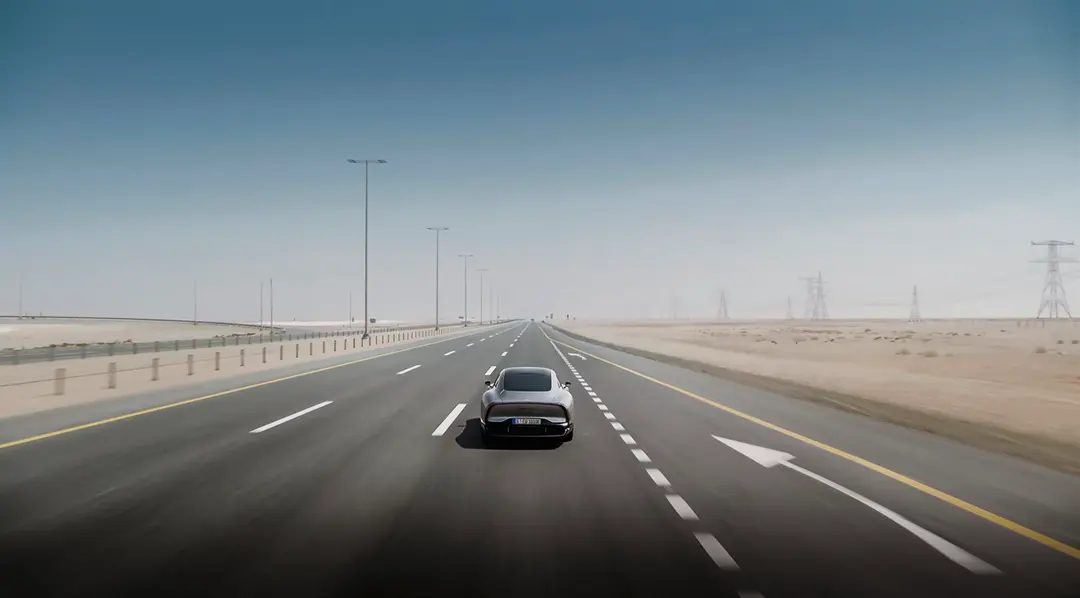
EQXX: 1001 km endurance run
The numbers don’t lie. The average speed is close to 80 km/h. More than 1000 km. No stopping. No sweating. Just pure, sustained efficiency. Vision EQXX proves that electric cars are no longer just for transporting groceries. They are prepared for the long game.
Mercedes didn’t just limp this prototype across the finish line. The range was 1,010 kilometers, which consumed less than three quarters of the total battery capacity. The car started the morning leg fully charged for the morning trip. When it crossed the finish line, the dashboard still showed 309 km to go. It’s not even close. This is a statement.
So how did they do it? This is not magic. This is physics. Especially aerodynamics. The drag coefficient reaches an astonishing 0.17. Most modern sedans struggle to break 0.25. This thing slices through the air like a knife. Every curve, every gap, every surface is carefully designed to reduce turbulence. As a result, less energy is needed to drive the car forward.
EQXX’s drag coefficient of 0.17 is the hero of this story.
Heat management is also important. We are talking about desert running. Temperatures often drain an electric car’s battery charge faster than a leaking gas tank. However, EQXX is equipped with a heat pump. Keeps the interior of your car comfortable without sucking the juice out of the pack. Effective thermal management is just as important as low drag when trying to maximize range.
There was one more trick up the sleeve. Solar panels are installed on the roof. They didn’t power the car entirely. But they add a little power. This panel generates 1.8 kWh of energy from sunlight. This corresponds to an additional distance of approximately 24 kilometers. small? Yes. Meaningful? Absolutely. When you’re pushing limits, every kilowatt hour is important.
Why this matters for future electric vehicles
Critics always ask if electric cars can handle real road driving. The answer to the question EQXX is a clear “yes”. Not under ideal laboratory conditions. on the actual road. With real traffic. And at high temperatures.
The battery wasn’t fully depleted. Most production cars ignore the safety margin of 309 kilometers. This prototype shows that with the right design, you don’t need to leave your car during the two-hour charging period. You can continue driving.
The sunroof is a nice touch. It’s not going to replace the grid. But this is an indication of where the industry is going. Harvesting ambient energy. Reduce waste. Every little thing helps.
Mercedes has shown the concept. The technology exists. The efficiency is there. The question is not whether long-distance electric travel is possible. It’s when it becomes standard. The EQXX didn’t just set a record. It sets a benchmark.