Check your tires first. If you see uneven wear, specifically more tread loss on the outside edges, your car is likely out of alignment. That’s the big red flag.
Beyond the rubber on the ground, other symptoms pop up while you’re behind the wheel. Your car drifts to one side. You think you’re driving straight, but you’re not. The steering wheel vibrates. You’re moving forward, but the steering wheel isn’t centered. If none of these feel familiar, check your owner’s manual. See what the manufacturer says about service intervals.
Everyone knows an alignment keeps your car running right. But the term doesn’t really refer to the wheels themselves. It refers to your suspension.
Everyday driving wears down suspension parts. Springs stretch out. A small accident. Bumping a curb. Any of these can knock highly calibrated components off-kilter. Your wheels end up sitting at improper angles. An alignment restores these angles to their correct measurements. It makes sure your wheels sit straight.
The most visible benefit is less tire wear. When tires do wear down, they do so evenly on a properly aligned suspension. Tires are expensive. Easily $100 or more per tire. An alignment often costs between $50 and $150. It’s a cost-effective procedure. It should be part of regular car maintenance.
An alignment ensures your car drives straight. It handles properly. The ride is safer. You also get better gas mileage. Properly aligned tires decrease resistance with the road.
On the next page, we’ll look at what happens during an alignment.
What Happens During an Alignment?
The Mechanics of Precision
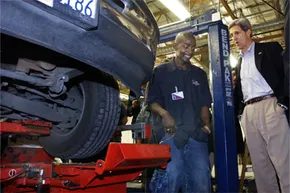
An alignment isn’t just a quick tweak. It’s an elaborate process of bringing your suspension into its proper configuration. You’re positioning and adjusting components so the wheels align with one another and the road surface. Do not attempt this yourself. You need an experienced mechanic. They use specialized machines to get it right.
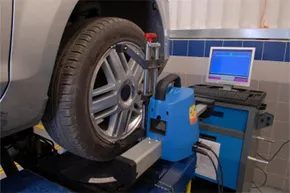
Newer equipment features clamplike devices. These attach to the wheels while the car is raised in the air. They link to a computer for precise measurements. The mechanic inspects suspension components simultaneously. Any worn or broken parts are flagged immediately.
The goal is simple. Square the car’s wheels and axles. They must move in the same direction. This involves adjusting specific suspension angles. These are known as toe, thrust, camber and caster. These four variables influence tire movement and position. The technician also ensures the steering wheel is perfectly centered.
Why Your Tires Are Wearing Irregularly
Every manufacturer designates standard angles. They are specified in degrees. If you drive a high-performance car or sports car, your mechanic might align your suspension differently. This can improve handling and tire performance. It still may lead to uneven tire wear. High-performance setups often sacrifice tire longevity for grip.
The type of alignment you receive depends on your vehicle’s suspension. A four-wheel alignment is reserved for all-wheel drive vehicles. It applies to front-wheel drive vehicles with independent or adjustable rear suspensions. Both axles must align properly. All four wheels form a rectangle. They are parallel to one another and perpendicular to the ground.
If you don’t have an all-wheel drive vehicle, you likely only need a front-end alignment. Only the front-axle components or thrust angles are adjusted here. The thrust angle refers to the angle the rear wheels point relative to the car’s center. In this scenario, the rear wheels and axle are realigned. They become parallel with the front axle and perpendicular to the center line of the car.
Practical Tips for Your Visit
After the alignment is complete, ask for a printout. It should show before and after images of the suspension alignment. This provides concrete evidence of the work done.
If you transport equipment or cargo, consider the load. It may make sense to put a typical load in your car when it’s being realigned. The suspension compresses under weight. This mimics real-world driving conditions. Otherwise, keep your vehicle relatively empty. Extra weight can skew the initial setup.
“An alignment essentially requires squaring a car’s wheels and axles with each other so that they’re moving in the same direction.”
The process is mechanical, not intuitive. It relies on data from computers and the expertise of the technician. Ignoring it leads to poor handling. You lose fuel efficiency. You wear out tires prematurely.
Sources like Hunter Engineering Company and Consumer Reports highlight the complexity. Charles Ofria’s breakdown of wheel alignment proves it’s a science. Gene Petersen’s work on tire wear shows the consequences of neglect. The Tire Rack offers tech info for those who want to dig deeper.
The gap between a perfectly aligned car and one that’s drifting is small. It’s measured in fractions of a degree. But the difference in driving feel is massive. You notice it the moment you let go of the wheel.
There are always new technologies emerging. Digital car diagnostics are becoming standard. Synthetic oil technology evolves. But the core principles of alignment remain rooted in physics. Gravity. Friction. Geometry.
If you drive hard, you’ll need adjustments more often. Track days destroy alignments faster than city commuting. The forces at play are violent. Components shift. Bushings compress.
Keep your suspension checked. The machines make it easier now. The computers reduce human error. But the mechanic’s eye is still essential. They see things the sensors might miss. A bent control arm. A worn bushing. These issues mask themselves until they cause problems elsewhere.
Don’t wait for the steering wheel to shimmy. That’s too late. The wear is already happening. The tires are singing their song of destruction. Fix it early. Save the rubber. Save your sanity.
The road is unforgiving. Your car should be ready for it.