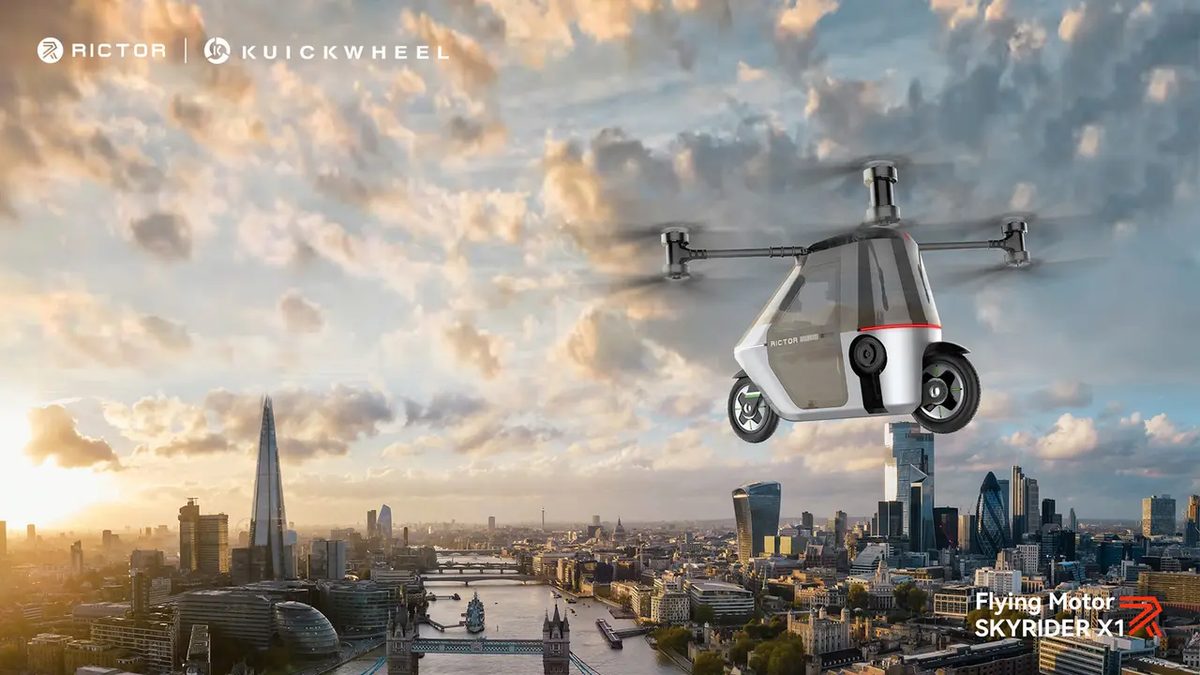
Las Vegas. The air smelled like ozone and hype. Rictor unveiled the Skyrider X1 at CES 2025. It is not a motorcycle. It is not a scooter. It is a flying vehicle that claims to be amphibious. The company currently sells only the K1, an electric bike that looks like a small motorbike. This prototype changes the narrative.
The press release calls it the world’s first amphibious flying motorcycle. That is a bold claim. “Amphibious” usually implies water capability. There is no evidence the Skyrider X1 can float. The rear wheel has two small stabilizer wheels. They keep it upright. The machine is likely too heavy to balance on its main tires alone. It sits on the ground like a tripod.
Vertical Takeoff and Landing Automation
The aerodynamics are distinct. Four deployable arms extend outward. Each arm holds two motors. That is eight rotors in total. The design mimics urban air mobility vehicles. Vertical takeoff and landing are built into the core.
You do not need a pilot’s license. Rictor says the system handles everything. Takeoff to landing is fully automated. You input a destination. The onboard computer navigates. If you want control, there is a joystick. Manual override exists. The default is autonomous flight.
Performance Specs and Battery Options
Speed tops out at 100 km/h. Range is the real question. Rictor offers two battery configurations. The X1 SL has a 10.5 kWh pack. It promises 25 minutes of flight time. That number feels optimistic. 25 minutes is short. It is insufficient for safe, long-distance travel. Safety margins vanish quickly at that duration.
The X1 SX model doubles the capacity. It uses a larger battery. Flight time extends to 40 minutes. That is better. Still not enough for cross-country commuting. But it is closer to practical.
Carbon Fiber Construction and Redundancy
Safety systems are triple-redundant. If one motor fails, the flight computer adjusts. The vehicle continues flying. A whole-airframe parachute is included. It deploys in case of catastrophic failure.
Weight management is critical. The frame and arms use aerospace-grade aluminum. Carbon fiber reinforces the structure. The materials keep the mass down. This allows the vehicle to withstand road stresses. It also aids lift efficiency.
Market Entry and Regulatory Hurdles
Rictor wants to sell the Skyrider X1 next year. The price starts at $60,000. Road homologation might be possible. Airspace certification is the real barrier. Most eVTOLs struggle here.
Except in China, no country has certified such vehicles for public air traffic. The Skyrider X1 faces the same regulatory wall. Road legality is one hurdle. Airworthiness is another. Both must be cleared before you can fly it. The CES display is just a proof of concept. Commercial reality remains distant.