Drum brakes rely on a delicate mechanical relationship. The brake shoes must sit close to the drum. They shouldn’t touch it during normal driving, but they can’t be too far away either.
If the gap grows too wide, the brake piston has to push further out to make contact. You feel this as a spongy pedal. It sinks lower than usual when you press it. This is exactly why most drum brakes have an automatic adjuster to manage that gap.
The mechanism relies on self-actuation. It works quietly in the background.
The Mechanics of Self-Adjustment
As brake linings wear down, a larger void opens up between the shoe and the rotating drum. The system waits for a specific trigger to close that space.
That trigger is reversing.
Each time you shift into reverse and brake, the internal geometry pulls the shoe tight against the drum face. This tension is key. If the gap has become significant enough, the movement forces an adjusting lever to rock.
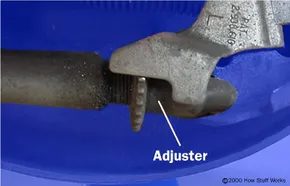
This lever engages a threaded gear. Think of it like a bolt turning in a nut.
The gear advances by exactly one tooth. Because the adjuster is threaded, that rotation causes the assembly to unscrew slightly. It lengthens. This extension pushes the shoe back toward its original position, filling the void left by the worn lining.
The cycle repeats as the brakes wear further. The adjuster keeps pushing the shoe closer to the drum, maintaining consistent pedal travel.
The Manual Override Exception
Not all systems rely solely on reverse braking.
Some vehicles use an emergency brake-adjusted mechanism. Here, the adjustment happens when you pull the parking brake.
This design has a weakness. If you ignore the handbrake for weeks at a time, the adjuster falls out of alignment. The shoes drift too far from the drum. You get that sinking pedal feeling again.
If your car uses this type of adjuster, you need to intervene. Apply the emergency brake at least once a week. It forces the mechanism to reset. It keeps the shoes in place.
Without that weekly tug, you are left guessing why your brake pedal feels loose. The mechanical gap is real. The fluid has nowhere to go but down.