Tractor trailers have a big problem with tires. They drop pressure. It happens. The Meritor Tire Inflation System (MTIS) stops this from ruining your trip. It is not a toy. It is a serious piece of hardware designed specifically for heavy-duty trailers.
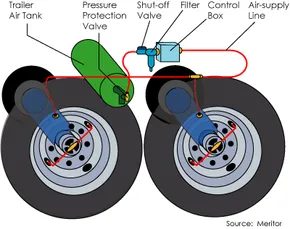
The system pulls compressed air from the trailer’s existing air supply. You do not need a separate compressor. This air moves into a control box. From there it travels into each axle. Simple mechanics.
Air lines run through the axles. They carry air to a rotary union assembly at the spindle end. This is the tricky part. The wheel turns. The union moves with it. Air flows through the union to each tire. If a tire pressure drops below the set point the system detects it.
If there is significant air-pressure loss an indicator light informs the driver.
The warning light is key. You get notified before a blowout happens or before you waste fuel on underinflated rubber. The overall system consists of two main parts. A wheel-end assembly handles the physical connection to the tire. A control module manages the logic and pressure settings.
This is how you keep rolling. The air goes where it needs to go. The pressure stays up. No more guessing.
Inside the Wheel-End Assembly
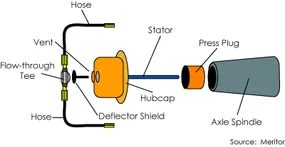
It starts with a flexible hose fitted with check valves. This hardware is the gatekeeper. It forces air into the tire but stops it from leaving. The logic is simple. If you are inflating one corner, the other three don’t drop pressure.
But the real mechanics happen inside the axle spindle. There, a stator sits quietly. It is a non-rotating part. Its job is to catch the air before it hits the spinning hub. The air moves through a tube from the stator into a flow-through tee attached to the hubcap.
Here is where it gets tricky. The hub spins. The tee needs to stay put or at least not leak. So, a dynamic seal bridges the gap. It allows rotation while keeping the pressurized air trapped inside the tube. No pressure loss. Just movement.
The hubcap assembly itself has two small but critical features. A vent prevents pressure from building up inside the wheel end. You don’t want a balloon ready to burst. A deflector shield keeps the gunk out. Dirt and water stay outside. The wheel end stays clean.
For axles with hollow spindles, a press plug does the heavy lifting. It seals the pressurized interior of the axle from the wheel end. The stator stays secure. The system holds.
“The dynamic seal allows rotation while preventing pressure loss when pressurized air passes from the axle to the hub.”
This is how you keep air in the tires without losing it to the environment. It is precise engineering. Small parts. Big consequences if they fail.
Valve Logic and Driver Alerts
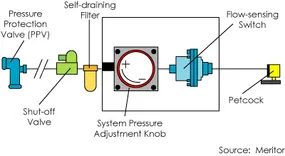
You’ve got a shut-off valve to kill the air supply entirely. That’s your master switch. Behind it sits a filter, stripping out moisture and grit before the air ever touches your tires. Then there’s the petcock. Use that to bleed pressure down to zero so you can actually work on the system without it fighting back.
Safety interlocks are built in, too. The pressure protection valve keeps the compressor from sucking air in if the reservoir drops below 80 psi. Don’t run it dry. It protects the pump.
Adjust the baseline with the system pressure adjustment knob. Change the set point as needed. The flow-sensing switch is the smart bit here. It triggers an indicator light on the dash. Why? Because if the compressor runs longer than usual, you’re likely filling a puncture. The light tells you something is wrong before you even look at the gauge.