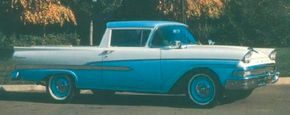
The 1957 Ford Ranchero wasn’t just a car. It was a declaration of war on the status quo. When Ford dropped this sedan-pickup hybrid, it sent the entire automotive industry into a panic. Competitors scrambled to copy what was essentially a two-door Ranch Wagon with its rear roof chopped off and a bed liner slid over the floor pan.
Ford claimed the inspiration came from “Down Under.” The Australian Ford Utility, or “Ute,” had been around since 1932. It was simple. A roadster with the back section replaced by a fleetside bed. But the 1957 American version? That was something else. It joined the Ford Courier Sedan Delivery in 1958, marketing a new breed of vehicle that blended suburban comfort with workaday utility.
Both were built by the Ford Truck Division on a shorter 116-inch wheelbase. They rode on the slick new 1957 styling cues that defined the era. Semi-elliptic rear springs with six leaves replaced the standard four. This gave the chassis a variable-rate effect. The result was stiffer action when loaded up, without sacrificing ride quality when empty.
Under the hood, things stayed relatively conservative. The base model ran a standard 223-cid straight-six. Want more power? You could spec the 272-cid V-8 in the base Ranchero or the 292-cid V-8 in the Custom. It wasn’t a monster by today’s standards, but in 1957, it was enough to make these things fun.
The timing was impeccable. The 1957 Ford Ranchero arrived at the New York Auto Show in December, following the main 1957 passenger line by two months. By April, it was already in movies. Pat Boone starred in April Love, giving the car its first musical debut.
General Motors and Chrysler were caught flat-footed. They hadn’t seen this coming. Dodge reacted quickly. They hobbled together an entire rear passenger wagon section and mated it to a pickup frame. The result was the finny Sweptside. It was ugly. Chevy and GMC just kept selling their existing Cameo and Suburban models. They were old news. Chevrolet didn’t catch up in a significant way until they launched the El Camino in 1959.
That left the spectacular Ford Ranchero alone in the spotlight for 1957. It was the only true sedan-pickup of its kind. The novelty drove sales hard. Ford moved 21,705 units that year.
Then came 1958. The facelift was a mistake. Ford tried to ape the Thunderbird’s bumper-grille design. They added strange-looking quad headlamps. They even stuck a dummy hood scoop on the front. It looked clumsy. Both the Ranchero and Courier kept the large round taillights from the previous year, but the front end killed the vibe. Sales plummeted to 9,950 units.
Why does this matter today? Because the 1957 model is a pristine artifact of automotive design history. It sits alongside 45-rpm records, pink and turquoise furniture, and Philco Predicta TV sets as a pinnacle of 1950s culture. Unlike those other items, however, the Ranchero had a lasting influence. It spawned a two-decade trend of car-pickup hybrids.
Collectors know the difference between the good years and the bad years. The 1957 Ranchero is highly sought after. The 1958 version? Not so much. Its body hardware is scarce. Rust is a constant enemy, attacking fenders, rockers, and floors. But for those who can find a survivor, the 1957 model offers a unique combination of comfort and hauling ability.
The Rarity of the 1957 Ford Ranchero vs 1958 Models
The production numbers tell the whole story. 21,705 Rancheros rolled off the line in 1957. That’s a lot of cars for a niche product. By 1958, that number was cut in half. The market rejected the facelift. The dummy hood scoop didn’t help. Neither did the awkward quad headlamps.
This makes the 1957 model significantly more collectible. It retained the clean lines of the original design.
The Muscle Truck Era
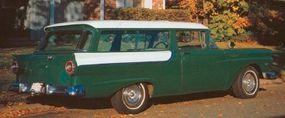
Ford’s early attempts at high-performance pickups were… well, they were heavy. The 1957–1960 F-Series with the Thunderbird V8 was the first real shot. It wasn’t fast, but it was loud. The 312 cubic-inch engine pushed out 230 horsepower. That was respectable for a work vehicle. But the handling? Terrible. The suspension was truck-tuned. You rolled like a boat.
Then came 1966.
Ford dropped the 289 cubic-inch small-block V8 into the F-100. This was the Ford F-100 high-performance truck that enthusiasts actually talk about. Horsepower jumped to 271. Torque was 312 lb-ft. The chassis was still live axle, but the power-to-weight ratio finally made sense. You could launch it hard. Rear tire smoke was common.
Chevy wasn’t sleeping. Their 1967 C-10 with the 350 cubic-inch V8 offered 300 horsepower. It was smoother. More refined. But Ford’s 302 V8 option in 1968 changed the game again. 230 horsepower wasn’t the headline. It was the feel. Light steering. Quick throttle response.
Why These Old Trucks Still Matter Today
You don’t buy a 1960s pickup for cargo capacity. You buy it for the soul. The mechanical connection. No computers. No drive-by-wire throttles. Just a carburetor, a camshaft, and a solid rear end.
Modern trucks are faster. A current-gen Silverado HD hits 60 mph in under 6 seconds. But does it have character? Does it shake your teeth loose when you drop the clutch? No.
The appeal of these classic high-performance classic trucks lies in their flaws. They’re twitchy. They wander at highway speeds. The brakes are adequate, not great. But when you floor it, the engine howls. You feel every bump. It’s raw. It’s honest.
And they’re still cheap. Well, not anymore. But compared to a modern V8 sedan? Still a bargain. You can pick up a decent 1969 F-100 for the price of a used sedan. Then spend another $20,000 restoring it. Worth it? Ask anyone who’s driven one.
The Modern Revival
Ford didn’t abandon the idea. They just hid it under diesel for years. Then came the SVT Lightning in 1993.
Supercharged 5.8L Triton V8. 380 horsepower. 400 lb-ft of torque. 0-60 in 6.2 seconds. It was ugly. Bulky. But it worked. People bought them. They worked hard. They also broke down. The supercharger pulley bearing failed. The transmission couldn’t handle the torque.
Then Ford slept again. For a decade.
Chevy tried with the 2006 Silverado SS. 6.0L V8. 393 horsepower. It was fast. But it was also expensive. And sales? Weak. Nobody wanted to pay $4