Father Jorge. That is who he was before the world knew him as Pope Francis I. Long before he was the head of the Catholic Church, he was a man in Buenos Aires who preferred the bus to the limo. Colleagues knew him as Cardinal Jorge Mario Bergoglio. He had the authority for a chauffeured ride. He didn’t take it. He liked the bus. He liked talking to people. It wasn’t just humility on display; it was a habit.
Then came March 13, 2013. The surprise election. For the first few days on the job, he was stubborn. He refused the popemobile for his first public appearance. Instead, he rode the bus with his cardinal buddies who had arrived at the conclave the same way. It was a statement. The next day, he swapped the bus for something slightly less aggressive but still far from the usual papal machinery: a Volkswagen.
Did the Vatican spokespeople mind? Not really. They were amused. But the reality of the job is heavier than the romance of the bus ride. The papacy brings stricter security. It brings stress. It brings a world that wants to do harm to its most visible figure. Under those circumstances, an armored Mercedes isn’t an extravagance. It’s a necessity. The Church hinted that Francis might eventually accept the luxury once he realizes Vatican City has limited public transit options.
But here is the thing. The Mercedes is just the latest link in a long chain of protected transport. And it is worth remembering that Francis is not the first pontiff to drive a Volkswagen.
The Glass Bubble on a Mercedes Chassis
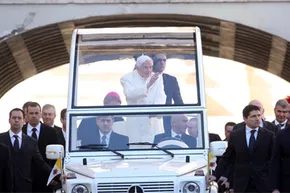
Most armored cars try to disappear. They are gray. They are black. They blend into traffic. The popemobile does the opposite. It is conspicuous. It looks like the Pope is exposed in a greenhouse-like glass bubble. He is. But the windows are bulletproof. The body panels are bulletproof. The underbody is bombproof.
If you think rappers with armored G-Wagens are tough, look at this. The current version is mounted on a Mercedes M-Class SUV. It has larger glass panels than its predecessor. A new feature for the 2012 model is the lighting. Integrated into the roofline, lights cast downward on His Holiness. The interior is white leather. It looks heavenly. The seat is embroidered with the papal coat of arms. The throne is on a hydraulic lift for easy entry.
Powering this beast is an ML430 V-8 engine. It takes a lot of power to haul armored glass. The motorcade usually moves at parade speeds. But the car can hit 100 miles per hour. That is 160.9 kilometers per hour.
Who pays for this? The Catholics don’t. Mercedes gives it to the Vatican. It is a long-standing tradition. The cost is about $500,000. Plus nine months of design and assembly time. You cannot buy that kind of publicity.
When the Pope needs to travel intercontinental, the official popemobile has to be schlepped around. Mercedes lowered the chassis slightly to make it easier to pack up and ship.
The current popemobile was built in 2012. The previous one served since 2002. They share common features. They show what the Vatican expects. Mercedes has been the supplier since the 1930s. They have an advantage here. They can armor vehicles at the factory. Few carmakers can make a return on this investment by servicing the secular market alone.
Security requirements mean resisting assault or ambush. It is a Mercedes specialty. It is impressive considering all that glass. Popemobiles are easily recognized for the telltale bulletproof glass platform on the back. That is not a guarantee, though. There have been exceptions. Only the official popemobile gets the papal seal on its doors.
The finish is usually a regal red carpet. The interior is white leather. Mercedes even has an exclusive paint color: Vatican Mystic White. No official specs on rim size. No in-dash electronics. But the style has definitely evolved.
A Dossier of Holy Rollers
The history of papal transport is not just about recent armor. It is about a lineage of vehicles chosen for protection and presence. While Francis made headlines with his VW, the trend toward heavy, custom-built German engineering has dominated for decades.
Mercedes-Benz has held the contract for so long that their factory armor capabilities are tailored specifically for high-profile religious leaders. This isn’t a retrofit. It is built-in. The distinction matters. When you are looking at which popemobile is which, look for the seal. Look for the glass. Look for the lift.
The shift from simple sedans to SUV-based platforms reflects the changing threats of the modern era. The ML430 engine doesn’t just move the Pope; it moves him fast if needed. 100 mph is not a suggestion; it is a capability buried under the ceremonial slow roll.
And yet, the image of Francis on that bus in Buenos Aires remains potent. It contrasts sharply with the $500,000 glass box. One is about connection. The other is about survival. The Church has decided that survival comes first now. The bus was a luxury he could afford to give up. The armor cannot be given up.
Whether Francis continues to resist the popemobile remains to be seen. He might acquiesce. He might find another way to be seen. The Mercedes will be there. Waiting. Engine running. Lights on.
The question isn’t just about the car. It’s about the man inside it. Can he keep the bus spirit in an armored bubble? The Vatican says the security demands leave little room for sentiment. But history suggests that sometimes, the most powerful statement isn’t the armor. It’s the refusal to wear it.
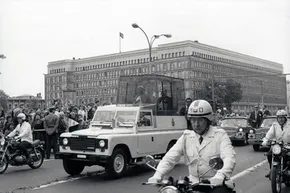
Most people think of the popemobile as a white, armored sedan. That’s a modern bias. Before 1981, there was no single mold. The Vatican didn’t have rigorous standards until Pope John Paul II took a bullet in St. Peter’s Square. Suddenly, security wasn’t a suggestion. It was mandatory. Before that? The local government just slapped together a vehicle for the Pope’s visit. If it had seats and a roof, the Church accepted it graciously. An assassination attempt on home turf changes your perspective pretty fast.
Early Armored History
The Vatican fleet didn’t start with armor. The first official Mercedes-Benz popemobile was a Nürburg 460 gifted to Pius XI in 1930. Thirty years later, Pius XII got a 300D Landaulet. The 60s brought variety. You had a 1964 Lincoln Continental for US visits. A 1965 Mercedes 600 Pullman. A 1966 Mercedes 300 SEL Landaulet. And a 1967 Mercedes 300 SEL.
By the 1970s, the design shifted. Cardinal Karol Wojtyla (John Paul II) pushed for a rolling throne based on the FCS Star. This was a Polish truck, usually for firefighting. It looked like a troop transporter. The design introduced an elevated platform and broad white panels. It was a departure from the sedan. A modified Ford Transit kept that theme going.
The Bulletproof Era Begins
Mercedes jumped into the truck trend in 1980 with a G230. It had a glass-enclosed rear platform. Peugeot followed in 1981. 1982 was busy. A Seat truck. A Range Rover. That Range Rover was notable. It was the first bulletproof popemobile design. A Leyland heavy-duty truck handled UK travel. The decade ended with a GMC Sierra and the first fully armored Mercedes limo.
The 1990s slowed down. Another Mercedes limo. Drop-top. And a bus for Mexico. Then, in 2002, the Vatican got a Mercedes ML 430. Fully bulletproof. Standard glassed-in platform. A Fiat Campagnola arrived in 2004. But it lacked an enclosure. It stayed inside Vatican City.
Electric Options and Urban Legends
In 2007, the request changed. The Vatican wanted a convertible popemobile. The Mercedes G500 SUV got modified. Folding windshield. Handrails. The Pope could feel the breeze.
Pope Benedict XVI cared about the environment. In 2012, he drove an electric Renault Kangoo Van ZE. The glass chamber wasn’t bulletproof. He used it in Castel Gandolfo. That’s a coastal town 24.1 kilometers from Rome. Security protocols were looser there. By late 2012, Mercedes delivered the latest armored rig.
There is confusion about these vehicles. Lore tends to fill the gaps. Take the story of Pope Benedict’s Volkswagen Golf. He bought a fourth-gen Golf new in 1999. He sold it after becoming Pope in 2005. It was never an official popemobile. It belonged to the cardinal, not the Vatican. It didn’t meet the security checklist. An online casino bought it for publicity. They listed it for sale in February 2013. The price was £127,000.
Would the former Pope buy it back? Unlikely. He’s 85. He hasn’t driven himself in nearly a decade. The Vatican has plenty of Mercedes limos with drivers. The Golf is just a car now.