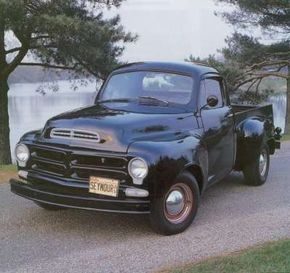
The 1956 Studebaker Transtar didn’t just arrive; it announced itself with a wider stance and a new name. While the styling bones dated back to the 1949 R-series, the changes for ’56 were specific enough to matter. The pickup box gained three inches in width. This forced a complete redesign of the tailgate and rear tread. For the first time, Studebaker offered an eight-foot bed on its half-ton models. That extra space changed the game for contractors and farmers who needed real utility, not just showmanship.
What Made the 1956 Transtar Different?
The visual shift was immediate. The previous model’s massive 465-square-inch rear window was gone. In its place came a more rounded hood featuring a large, open “Studebaker” nameplate right in the front. The branding was aggressive. The name stretched across the entire width of the hood on earlier models, but here, it was front and center. Headlight rims grew larger to house the parking lights. A new V-S hood ornament appeared on equipped trucks, while the six-cylinder models sported a red “S.”
Studebaker also played the color game hard. In 1955, buyers favored two-tone finishes, accounting for 80 percent of sales. The 1956 Transtar doubled down on this. The “Transtar” badge moved to the front edge of the doors. Eight-cylinder models showed a V-8 emblem on the back edge of the hood. You could spot a DeLuxe cab option by the word “DeLuxe” sitting below the Transtar nameplate. This upgrade cost $31.82. It was a small price for a truck that looked like it belonged on a magazine cover rather than a muddy job site.
Under the Hood and in the Cab
The mechanicals kept pace with the styling. The electrical system underwent a critical flip. Studebaker moved from a six-volt positive ground to a 12-volt negative ground system. This wasn’t just a tweak; it was the modern standard. Key starting became the norm. Before this, standard-shift models used a starter button tucked under the clutch pedal. That setup was awkward. Keys were better.
The engine options remained largely identical to 1955, but the drivetrain got a headline feature. Studebaker introduced Twin Traction, a limited-slip differential. It cost $26.52 as an option. More importantly, it was the first time any manufacturer had offered this feature on a truck. For drivers in snow or mud, traction was no longer a gamble. The 1956 models were designated as the 2E series, a technical marker for collectors today.
The Rise and Quiet Fall of the South Bend Truck
To understand the Transtar, you have to look at the R-series. Introduced in spring 1948, the R trucks were the best-selling line in Studebaker’s history. By 1949, they held 5.73 percent of the industry registrations. For an independent manufacturer in South Bend, Indiana, that was dominant. They were priced right. They were handsome. They had features competitors ignored. Dealers in rural communities loved them because trucks were their bread and butter.
But momentum is fragile. Management stopped treating the truck division as a priority. Market forces shifted. By 1959, Studebaker’s share had plummeted to roughly half of one percent. The Transtar was a strong attempt to arrest that decline, but the tide was too high.
Production continued until 1964. The last trucks rolled off the line before the South Bend plant closed in December 1963. Sales were so minuscule in the final years that they didn’t justify production in Canada either. The Transtar remained a sharp, well-equipped pickup for a brief moment. Then it vanished.
Key Specifications and Options
- Body Styles: Half-ton pickup with standard and new 8-foot bed options.
- Dimensions: Pickup box widened by 3 inches for 1956.
- Electrical: Upgraded to 12-volt negative ground with key ignition.
- Drivetrain: Optional Twin Traction limited-slip differential ($26.52).
- Trim: DeLuxe cab option available for $31.82.
- Badging: “Transtar” on door front edge; V-8 emblem on hood rear edge for 8-cylinder models.