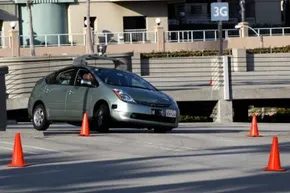
Ninety-five percent of car crashes are caused by human error. It’s a staggering stat that has led Google to bet big on a solution that feels like science fiction: the driverless car.
The concept relies on artificial intelligence software working in tandem with high-tech sensors and cameras. The result is a vehicle that requires zero input from you. But Google isn’t alone in this race. Automakers like General Motors have been eyeing the autonomous vehicle sector for years. Despite the hype, we are still roughly a decade away from seeing these vehicles lining dealership lots. The biggest hurdles aren’t technical—they’re legal. Government regulation, liability laws, and privacy concerns are the real bottlenecks.
The Legal Red Tape
For a long time, operating a concept car was illegal in all 50 states. That changed in June when Nevada passed a bill authorizing the Department of Transportation to create regulations for driverless cars. This move opens the door for the technology to eventually go mainstream.
But creating rules for uncharted territory is messy. If a driverless car gets into an accident, who is at fault? The software? The “driver”? We’re still figuring that out.
“The technology is ahead of the law in many areas,” Bernard Lu, senior staff counsel for the California Department of Motor Vehicles, told the New York Times. He pointed out that dozens of existing vehicle code laws presume a human is behind the wheel.
The Tech Behind the Wheel
Strip away the red tape, and autonomous cars promise a safer, more efficient mode of transport. In a March TED talk, Sebastian Thrun, a Stanford professor who helped build Google’s self-driving car, painted a picture of saturated roads. Highway capacity could double or triple. Traffic jams would vanish. Car accidents, the number one killer of young people, would be a thing of the past.
How does it work? Robots react faster than humans. They see 360 degrees. They don’t get sleepy, drunk, or distracted by text messages. Google engineers say the cars use a variety of sensors to detect objects nearby, determine if they are moving, and calculate speed. The car then adjusts accordingly.
If Car A (driverless) is doing 60 mph on the highway and falls behind Car B doing 55 mph, adaptive cruise control automatically reduces Car A’s speed to maintain a safe distance.
Sometimes accidents are unavoidable. Pre-safe systems—now common in luxury cars—anticipate crashes by priming brakes and reducing engine power. If a crash seems imminent, the system prepares airbags for deployment and tightens seatbelts. It does all this in less time than it takes a human to slam on the brakes.
Interestingly, a Google driverless car got into its first crash in Mountain View in August. It was being driven manually by a human.
Driving More Efficiently
These smart cars can keep closer distances to other vehicles while driving more safely. This decongests roads and reduces commute times. Thrun noted in his talk that the average person spends 52 minutes in traffic per day. That’s time wasted. In the U.S. alone, that adds up to 4 billion hours wasted annually and 2.4 billion gallons of gasoline.
Not all roads are equal. Google’s driverless car has already logged 140,000 miles on city streets, highways, and mountain roads around the world. It handles day and night conditions, traffic lights, stop signs, and toll booths. The precision is so high that parking becomes a non-issue, no matter how tight the spot.
“I think there is a vision here, a new technology,” Thrun said. He looks forward to a time when future generations look back and think it ridiculous that humans were driving cars.
They might not have long to wait.