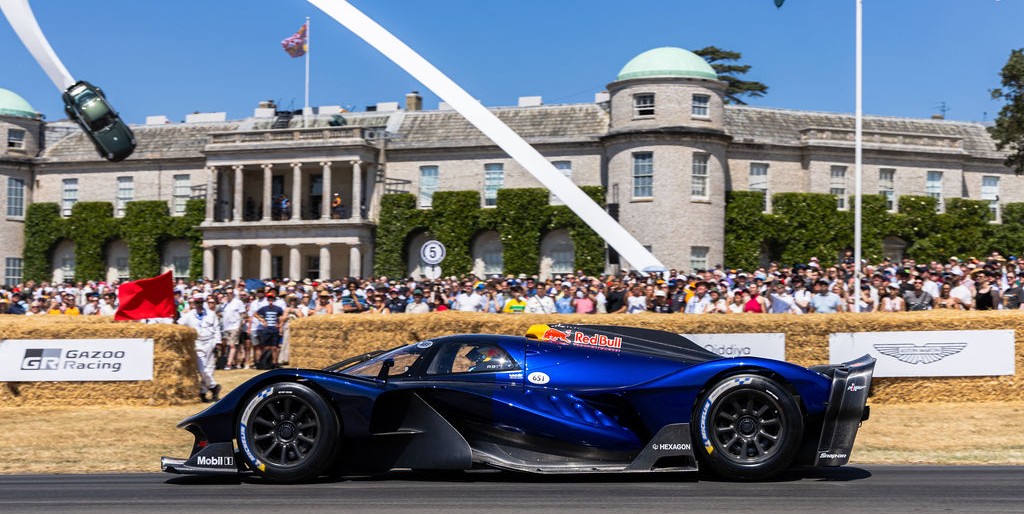
Most of the weekend, the car wore a coat of gray. Not intentional. Just fine Southern England dust, baking on those sleek surfaces while fans sweated through the heat. Red Bull’s RB17 sat on its pedestal at Goodwood looking like it hadn’t seen a wash rag since March.
Some of that grit is just bad luck. Dry winds. The 11th Duke of Richmonds’ estate getting hotter every summer.
The rest? Blame Adrian Newey.
Or maybe excuse him.
“He did take a bit of grass… but apparently that’s the normal line.”
Here is the thing people keep missing. Newey left. He departed Red Bull for Aston Martin back in March 202025. Sixteen months gone. So why is the man who designed it holding the steering wheel at its public reveal?
He was an “obvious candidate,” said Rob Gray from Red Bull Advanced Technologies. A passion project. A final farewell gift wrapped in carbon fiber and noise.
They didn’t time it. Didn’t try to beat anyone. Just a shakedown run. Five hundred kilometers total on the chassis before this. The doors open. Mirrors work. Safety gear is bolted down. But don’t expect race pace. Just look good. Sound awesome. Cut the corner at Turn 2. Chew up a patch of grass. Drive on.
The Noise Problem (Solution)
Forget NASCAR. Forget vintage formula cars. The RB17 is the loudest thing on site.
By design.
Red Bull didn’t build this to fit rules. No homologation hoops to jump through for road use. They built a track toy. A hardcore, bespoke machine with a Cosworth 4.5-liter V-10 screaming from the rear.
Cosworth hasn’t built an F1 engine since 2013. They moved to the supercar world. But when they started work with Red Bull in 2022? The plan was different. Twin-turbo V-8 first on paper.
Then the heart won over the math.
“The heart definitely said V-10… high-revving.”
Chris Willoughby from Cosworth admits it wasn’t just simulation data. It was emotion.
A twin-turbo V-8 has lag. The V-10 has immediacy. It snaps when you poke the pedal. But there is more. V-12 cars are out there. GMA’s lineup. Aston’s Valkyrie. Everyone seems to be going twelve-cylinder. Red Bull chose ten. It’s smaller. It adds rigidity to the chassis as a structural member.
And that sound. That high, metallic scream. It calls back to F1 between 1989 and 2005. The best aural era in motorsport history.
To hit 12,000 or 13,000 rpms? They borrowed tricks. Gear-driven cams. Pneumatic valve springs from MotoGP tech. Keeping valves from floating when things get wild.
Usability? A Myth?
F1 engines are fragile. Tolerances are so tight they won’t turn cold. You need block heaters. A team of fifty engineers. Then you scrap it after one session.
The RB17 isn’t for that.
It has to last. Customer track days mean real people driving. People without a crew chief breathing down their neck.
So Cosworth learned something new from the racing world. Piston rings pushed to the top. Reduces trapped air. Squeezes more performance out of the combustion. Also reduces emissions. A happy accident.
At Goodwood so far? They only hit 10,000 revs. Gentle, relatively.
The aerodynamics evolved too. The 2024 show car is dust. Now it’s got a semi-detached rear end. Fins. Massive ground effects. An active diffuser to save tires when you aren’t chasing a lap record.
Scaling the Monster
You buy this car? You aren’t just thrown into the deep end.
Gray talks about simulators. “Encouraged” is the word.
Then you get modes. Power limits. Rev limits. Dials to turn.
The goal is user-friendliness for the insane.
If you usually drive a Porsche GT3 on weekends? That is your starting line. Not F1. Not LMP1. Start slow. Grow with the car. The software lets you tame the beast. You can dial in exactly how much terror you can handle before you unleash the V-10.
Adrian Newey drove it up the hill. Yuki Tsunoda—Red Bull’s reserve driver—also got a turn. The sound was pure race car. Ripsaw idle. Nothing like the polished, muffled growls of road-legal supers parked in the paddock nearby.
Rumors started. A separate company trying to make it road legal? Maybe. Probably not.
The Bill Comes Due
Production was promised for 2025.
Reality is slower.
Assembly just started this May. Deliveries? Likely 2027. Maybe 2028. Fifty customer cars total.
The price? $7.5 million. Roughly. Currency fluctuates, but let’s round to the nearest seven-figure sum that breaks your heart.
Does it compare to the cost of an actual Formula 1 chassis? No. An F1 car costs way more and doesn’t even have a V-10 anymore.
So for the well-heeled elites in their Panama hats and linen suits at Goodwood? It’s a bargain. A screaming deal for the noise and the status.
Max Verstappen didn’t drive it.
The four-time world champion hasn’t touched the prototype. His contribution? Data. Years of telemetry. Driving insights fed into simulations that Newey’s team used to shape the car. He provided the brain. The data.
The dust.
That’s just dust.