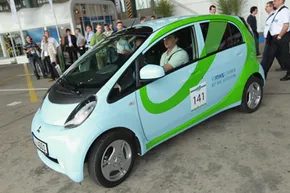
Most people picture a Nissan Leaf when they hear “electric vehicle.” It’s a hatchback. It fits five people. It’s practical. The Mitsubishi i is even smaller at just 62.4 inches wide. Logic dictates this trend. Smaller cars weigh less. Less weight means more range from the same battery pack. It is a simple physics equation.
But scientists in Switzerland and the Netherlands took the “less is more” philosophy and broke it.
They built what is technically the world’s smallest electric car. Do not look for cargo space. Do not expect it to commute you to the office. It has standard four-wheel drive, but you will need a microscope to see it.
A Molecule With Wheels
This isn’t a car you park in a garage. It is a custom-designed molecule. Specifically, it has a stem with four branches. It looks like an uppercase H.
Each branch rotates. They act as wheels.
The power source? A scanning tunneling microscope. The tip of that microscope is the size of a single atom. When it gets close to the molecule, electrons jump from the microscope to the car. The wheels absorb that charge. They change shape in a rolling motion. The entire molecule moves.
One charge moves the vehicle about six billionths of a meter. That is tiny. It is also incredibly precise.
Operating Conditions
There are catches. A lot of them.
You cannot drive this on a highway. You cannot drive this in the rain. The experiment requires a vacuum. The temperature must be minus 446.8 degrees Fahrenheit. That is minus 266 degrees Celsius. It is colder than most places in the universe.
So why build it? The scientists admit they are not entirely sure yet. But it points to a new direction in nanotechnology.
Why Start Small?
Most tech starts big and shrinks. Computers once filled entire floors. Now they fit in your pocket. Nanotechnology flips that script. It starts with matter at the smallest possible scale.
By manipulating individual molecules, researchers hope to create new machines. They might engineer new proteins. They could build organic materials that do not exist in nature. We may never ride in this electric car. But it could be the foundation for other advances.
Just remember where you parked it. You won’t be able to find it with your eyes.