Choppers start life as traditional motorcycles or cruisers, but they don’t look like your average bike. A sport bike pushes the rider forward into a hunched position. A chopper does the opposite. You sit low. You lean back. Your arms stretch out. It’s a relaxed stance, but it demands a specific skeleton to make it work.
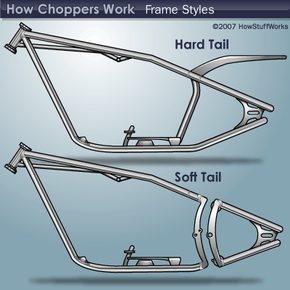
That skeleton is the frame. If you want that stretched-out, low-slung look, the frame has to be right. There are only two main types you’ll encounter: hard-tail frames and soft-tail frames.
What is a hard-tail frame on a chopper?
A hard-tail is solid. One piece. No rear suspension.
This is the classic look enthusiasts chase. The lines are clean, unbroken, and distinctly “chopper.” But there’s a tradeoff. Without rear suspension, every bump goes straight through the frame into your spine. It’s a bumpy ride. If you value aesthetics over comfort, this is the way to go.
How does a soft-tail frame differ?
Soft-tail frames have rear-wheel suspension. That changes the construction entirely.
The frame comes in two major pieces:
1. The front section, where you mount the engine, transmission, fork and handlebars.
2. The rear section, which holds the rear wheel.
You bolt these two sections together using brackets, spacers, and various hardware, depending on the manufacturer. It’s more complex than a hard-tail, but it lets the rear wheel move independently. That movement absorbs shocks, making the ride smoother while still maintaining the chopper aesthetic.
Where is the fork assembly located?
Regardless of whether you’re looking at a soft-tail or hard-tail, the front end is where things get mechanical.
The fork assembly connects the front tire and handlebars to the main frame. It’s not just a structural link. It includes the front wheel suspension system. This usually operates via springs or hydraulics. It’s the first line of defense against road hazards.
What does “stretching the frame” actually mean?
Chopper builders speak a specific dialect. If you overhear two guys talking about their projects, you might hear someone say, “My bike is two inches ahead and two inches up.”
They aren’t talking about the speedometer. They’re talking about the frame geometry.
- The top rail of the motorcycle frame is called the backbone.
- The rails in front are called the downtubes.
To create that aggressive chopper look, builders alter the frame by stretching these rails. They cut the existing metal and weld in new sections to increase the length. “Two inches ahead and two inches up” means the builder added two inches to the backbone and two inches to the downtubes. This changes the bike’s shape, rake, and trail, fundamentally altering how it handles and looks.
It’s not just cosmetic. Those extra inches change the wheelbase and the angle of the steering axis. That’s why the frame isn’t just a structure. It’s the definition of the bike’s character.