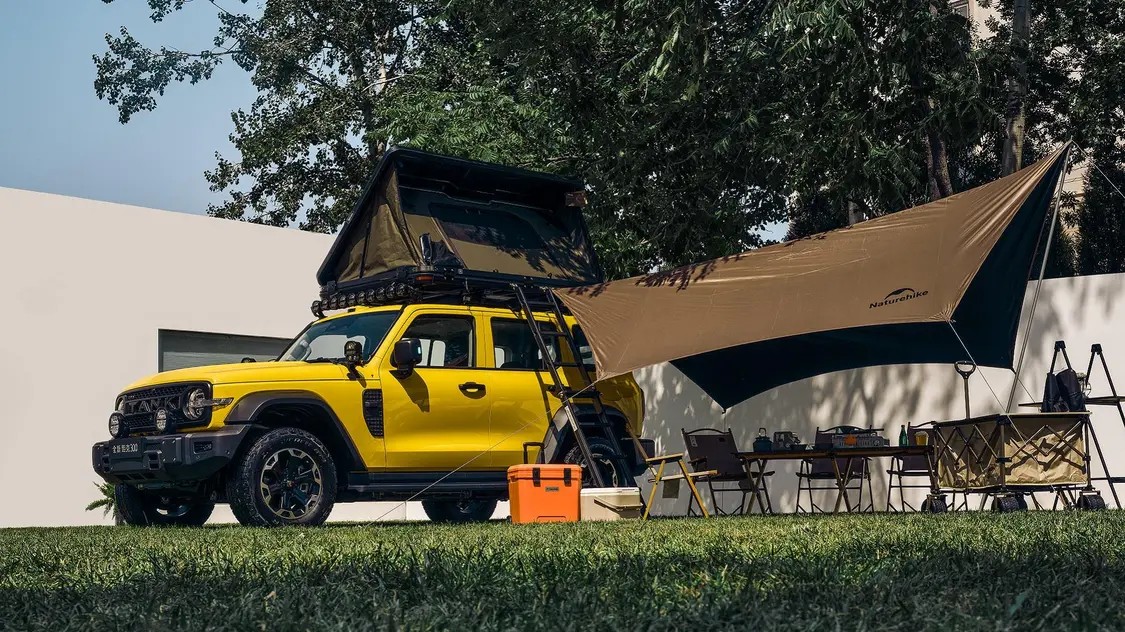
The Tank 300 is no longer just a weekend warrior’s toy. It has grown up. Or at least, it’s trying to be everything to everyone now. Great Wall Motors officially expanded the lineup on July 19, 2025. (Note: Source says 2026, but industry rollouts often lag or previews happen a year out; assuming the provided date is the launch target). They’ve split the family. One group stays rugged. The other gets comfy.
You can choose between short-wheelbase models built for mud and rock crawls. Or you can pick long-wheelbase plug-in hybrids designed to glide through city traffic without the guilt—or the fuel bill.
How the Standard Wheelbase Handles the Rough Stuff
Stick to the short version if you care more about getting out of a ditch than getting to a corporate brunch on time.
The standard-wheelbase gasoline and diesel variants keep the soul intact. You still get the 4H and 4L modes. Crawl control is there. The “tank turn” feature (where you spin on a dime) is still active. These aren’t lifestyle badges. They are functional hardware.
Gasoline power comes in two trims: Challenger and Conqueror. Both use the same heart. A 2.0T engine pushes against a longitudinal 9AT transmission. The output is 162 kW (about 217 hp) with 380 Newton-meters of torque. It’s punchy. Reliable. Traditional.
There’s a diesel option too. The 2.4T variant makes 135 kW (181 horsepower). But look at the torque. 480 Newton-meters. That’s heavy. It’s built for long-distance expeditions. You know the type. Low-speed crawling over logs. High torque when the engine is stumbling. Great Wall added better sound insulation too. So it doesn’t rattle your teeth out when you’re idling in the dark. And cold-start reliability? Enhanced. If you live in Minnesota or Montreal, this matters.
The Long-Wheelbase Hi4-T and Hi4-Z: Urban Utility Meets Speed
Then there’s the Tank 300L. Yes, they added an “L” to the badge.
The wheelbase stretches from 2750mm to an imposing 3010mm. Why? More legroom. More cargo space. A smoother ride over cracked asphalt. It bridges the gap. You want off-road capability for the weekends? You get it. You want a daily driver that doesn’t feel like riding a tractor? You get that too.
But the real headline is the battery.
The Hi4-T model. It packs a 37.1 kWh lithium-ion battery. WLTC pure electric range sits at 105 kilometers. That’s enough for a decent commute without burning a drop of gas. Max power? 310 kW (414 hp). Torque is 750 Nm. Quiet. Smooth. Electric torque delivery hits instantly.
The Hi4-Z is the beast.
Forget the smaller battery. The Hi4-Z jumps to a 59.6 kWh pack. WLTC electric range jumps to 200 kilometers. Think about that. 200 kilometers of zero-emission driving before you even think about the generator kicking in. Combined system output? A staggering 560 kW (roughly 751 hp). Torque hits 1,195 Nm.
0-100 km/h? 4.3 seconds. In an SUV that looks like a brick with round headlights. That’s fast. Brutally fast.
Does Length Kill the Crawl?
Longer cars usually suck off-roading. The breakover angle takes a hit. Ground clearance suffers.
Not here. Great Wall kept the geometry tight. The approach angle is now 38 degrees. That’s generous. Minimum ground clearance holds steady at 234–235 mm. Compare that to the 224 mm on the standard short-wheelbase models. Wait. Clearance is higher on the long version? That’s counterintuitive but true in the specs provided. It suggests careful engineering to preserve underbody protection despite the extra length.
The long-wheelbase models don’t sacrifice