Lift a paperback book. Easy. You don’t break a sweat. You might even toss it from one hand to the other without thinking. Now try to carry a sofa. Or a flatscreen TV. Your muscles engage. Your heart rate climbs. You sweat. The effort is real.
Cars behave the same way. Drive empty. The engine idles. Fuel consumption drops. The drivetrain barely notices you’re there. Load up the trunk with every possession you own from your apartment. Drive across town. The vehicle drags. Acceleration lags. Gas mileage plummets. Physics doesn’t care about your convenience.
This is true for any machine. Extra mass demands extra energy. Extra energy generates excess heat. And heat is the enemy of mechanical longevity. Too much thermal buildup damages the engine. It leads to costly repairs. Or a complete breakdown in the middle of nowhere. Your transmission faces the same threat. It is a complex assembly of gears, clutches, and fluid. It hates heat.
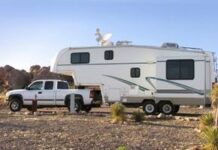
Tow vehicles carrying thousands of extra pounds of trailer weight do much more work than regular cars and they create lots of heat under the hood.
When you tow a trailer, the stakes rise dramatically. You are moving thousands of pounds of extra dead weight. The engine works harder. The transmission shifts more frequently under load. Heat builds up rapidly. Factory cooling systems are often sized for the curb weight of the vehicle. They are not sized for towing.
Many enthusiasts and daily drivers install transmission coolers to mitigate this risk. But how do they work exactly? Are there different types? And where do you mount them?
Choosing Transmission Coolers
The market is flooded with options. Some are simple. Some are over-engineered. Choosing the right transmission cooler for your truck or SUV depends on your specific setup. What are you towing? A light camper? A boat? A fifth wheel? The load dictates the cooling capacity you need.
Types of Transmission Coolers
There isn’t one universal solution. You have a few primary configurations to consider.
- Inline coolers: These are small, compact units. They fit into the cooler line of the transmission. They are easy to install but offer minimal cooling capacity. Good for light duty.
- Stacked plate coolers: These use multiple thin plates to maximize surface area. They dissipate heat efficiently. They are a popular choice for moderate towing.
- Tube and fin coolers: Similar to a radiator. They have internal tubes for fluid flow and external fins for air cooling. They handle high heat loads.
- Dual pass coolers: These force the fluid to travel through the cooler twice. This increases the time the fluid spends cooling down. Better heat rejection than single pass.
- Auxiliary electric fans: For vehicles with limited airflow, like those with large grilles or off-road bumpers. An electric fan can pull air through the cooler when the vehicle is stationary or moving slowly.
How Transmission Coolers Work
The mechanism is straightforward. Automatic transmission fluid (ATF) circulates through the transmission. It absorbs heat from the gears and clutches. Hot fluid travels out of the transmission via the cooler line. It enters the transmission cooler. Air flows over the cooler’s fins. Heat transfers from the fluid to the air. Cooled fluid returns to
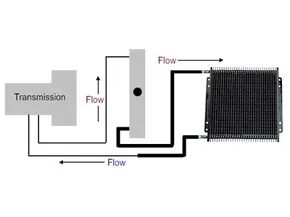
Transmissions are under constant siege. They have to keep engine RPMs in a usable band while shoving power to the drive wheels at speeds ranging from a creeping 1 mph to a screaming 100+ mph. That friction generates immense heat. To stop the gears from melting into slag, transmissions rely on transmission fluid—a slippery, oily coolant that lubricates and cools the internal moving parts.
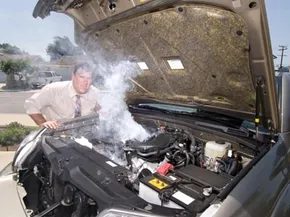
But fluid alone isn’t always enough. Under heavy load, temperatures can spike past the safe 160 to 200-degree Fahrenheit (71 to 93 Celsius) threshold. When the fluid hits that ceiling, it starts to burn. You lose volume. Pressure drops. And suddenly, you’re looking at a destroyed transmission, which is arguably the most expensive repair on a modern vehicle. Most owners only think about this when the smoke starts rolling.
Installing a transmission cooler is the logical insurance policy. It’s standard practice on tow vehicles, RVs, and heavy-duty trucks. But picking the right one isn’t just about grabbing the cheapest unit at the auto parts store. You need to match the hardware to your specific towing profile.
Matching Cooler Capacity to Your Rig
The first variable is your vehicle itself. Not just the truck, but the entire setup. How much does the tow vehicle weigh? How much payload are you carrying in the bed or cabin? And critically, what is the trailer weight? You need to know if you’re hitting peak capacity regularly.
You have to match the transmission cooler to your Gross Vehicle Weight Rating (GVWR). If the cooler is undersized for your GVWR, it won’t dissipate heat fast enough. You can look up these specs online, or ask a pro. Don’t guess. Guessing costs thousands in repairs.
Terrain Dictates Cooling Needs
Where will you be driving? Flat highways are easy on a transmission. Stop-and-go city traffic is harder because you lose airflow while idling. But mountainous terrain? That’s the real killer. Climbing a steep grade at low speed with a heavy load generates massive thermal energy. The engine works overtime. The transmission fights to hold gears.
If you’re planning to tow in the Rockies or the Smokies, your cooling system needs to be robust. A small inline cooler might handle a weekend trip to the lake, but it will fail on a sustained climb. You need to think about the worst-case scenario, not just the average commute.
The Installation Process
Once you’ve picked a unit that fits your weight and terrain profile, you have to install it. This isn’t just bolting a radiator to the front bumper. You’re integrating a new heat-exchange loop into your existing hydraulic system.
Most installations require tapping into the transmission fluid lines. You’ll need to cut the existing hose and insert the cooler in series. This means your fluid now flows through the cooler before returning to the transmission. Some setups use a separate fan if the cooler isn’t mounted in front of the main radiator where airflow is sufficient.
You’ll also need to consider mounting location. Front-mounted coolers get the best airflow but are vulnerable to rock strikes. Rear-mounted or integrated coolers are safer but might get less air.
Installing a Transmission Cooler
“A properly sized cooler extends the life of your transmission by keeping fluid temperatures below the degradation point, preventing varnish buildup and seal failure.”
Choosing the Type
You have three main options when installing a transmission cooler :
- Inline Tube-and-Fin Coolers: These look like small radiators. They’re cheap and effective but require significant space in the front bumper area. They rely on vehicle speed for cooling.
- Plate-and-Fin Coolers: More compact. They fit in tighter spaces and often have better heat transfer efficiency per square inch. They’re a popular choice for modern trucks where bumper space is at a premium.
- Transmission-Oil-to-Air Coolers with Fans: These are self-contained. If you’re towing in traffic or crawling over rocks, a dedicated fan ensures cooling even when the truck is stationary. This is crucial for off-road towing or severe city commuting.
The Plumbing Challenge
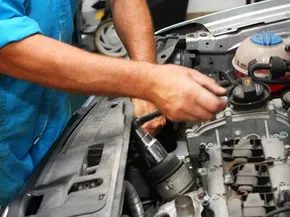
Choosing the right spot for heat rejection
You picked the cooler. Now you have to mount it. Most kits arrive with the hardware and manuals included, so DIY isn’t out of the question. But placement matters. You aren’t locked into one engine bay coordinate. Still, efficiency depends on airflow.
Don’t hide it behind the bumper. Airflow there is stagnant. You waste the unit’s potential. Front-mounting is the standard for a reason. Place it in front of the radiator and the A/C condenser. Air hits it first. Debris hits it last. You get cooling without the risk of rocks puncturing the core.
Hardware and hose routing
Most coolers are thin and square. This geometry lets them slide into tight spaces. Adhesive pads are common. They stick the unit directly to the radiator tank. If you prefer rigid support, use the provided rods. Slide them between the radiator fins and the cooler’s flanges. It’s a solid mechanical lock.
Fluid dynamics are next. Connect the inlet and outlet lines to the transmission. That’s the only way cooled fluid reaches the gearbox. Pay attention to routing. Keep hoses away from hot manifolds. Keep them away from spinning fans. Heat adds load to the cooler. Moving parts destroy lines. A severed hose means a stranded tow.
“Mounting the cooler in front of the radiator and the air conditioning condenser is typically considered the best place.”
For deeper dives into towing safety and vehicle dynamics, check the related articles below.
Lots More Information
Related HowStuffWorks Articles
-
How Leaf Springs Work
-
How to Load and Unload Towed Vehicles
-
How Backing Up Towed Vehicles Works
-
How Boat Towing Safety Works
-
How Launching a Boat Works
-
What’s the safest way to brake when I’m towing?
-
How to Brake While Towing
-
How to Shift While Towing
-
How to Turn While Towing
-
How to Pass While Towing
-
How Gross Vehicle Weight Rating Works
More Great Links
- AutoMedia.com
Sources
-
AutoMedia.com. “Transmission coolers.” (Sept. 22, 2008) http://www.automedia.com/Transmission_Coolers/pht20011001tc/1
-
Automotive Accessories Connection. “Transmission oil coolers.” (Sept. 22, 2008) http://www.accessconnect.com/oilcoolers.htm
-
eTrailer.com. “Transmission coolers.” (Sept. 22, 2008) http://www.towtown.com/catalog/c49.html
-
Transmission Cooler Guide and Installation. “Automatic transmission coolers and engine cooling products.” Bulkpart.com. 2008. (Sept. 22, 2008) http://www.bulkpart.com/transmission-cooler.html
-
TransmissionCoolers.us. “Choosing the correct transmission cooler.” (Sept. 22, 2008) http://www.transmissioncoolers.us/Merchant2/merchant.mvc?Screen=CTGY& Category_Code=guide
-
U-Haul.com. “Transmission coolers.” (Sept. 22, 2008) http://www.uhaul.com/hitches/transmission-cooler.aspx